Showing posts with label Postage Stamps. Show all posts

Saturday, September 13, 2008

Last template fix for today

I have yet to update the 'Other Favorites' and "Stamp Collecting Links'--more updates to come!

I deleted the Ghost Town Orange Weather service and upcoming news service although the original posts they link to are still there...maybe I'll update it with my current location...

More columnists have been added to the favorite columnist list. I suppose I could add Paul Krugman and Stanley Fish from the New York Times...

I really need to update the picture at the top...

Peace

The technical imperfections occasionally seen in these posts are original flaws inherent given human fallibility. They are presented for their historic value and should be judged in that context. Loose threads and fraying seams are evidence of this handcrafted blog's extreme high quality.

Wednesday, May 17, 2006

Too many irons in the fire

Alas, I succeeded in locking up the computer I'm working with, and will not be able to post any pictures before tonight's choir practice. So I should be able to post some pictures between 9:00 and 10:00 pm Central time tonight.

On a totally unrelated note, I have finally kept a New Years' resolution to my self to start creating an album for Japanese postage stamps--some of the most beautiful and interesting in the world, in my humble opinion. Yesterday I started with some of the older and definitive issues [i.e., the ordinary small stamps that are used on most mail]. After I finish those, I'll start on the larger pictorial and commemorative stamps. I hope to post some stories about the different things celebrated on Japanese stamps. The first will be about the long-tailed cocks of Tosa. You can google that on your own now, but I'll try to include pictures of the stamp too.

God our security,
who alone can defend us
against the principalities and powers
that rule this present age;
may we trust in no weapons
except the whole armor of faith,
that in dying we may live,
and, having nothing, we may own the world,
through Jesus Christ. AMEN
--Janet Morley, All desires known, 1988

Friday, January 13, 2006

Postage Stamp Mosaics


Source: Chinanews

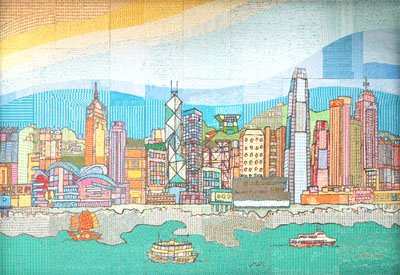
On 30 August 2005, Hong Kong Post unveiled a gigantic stamp mosaic to commemorate the 10th Anniversary of the 'Post Office Trading Fund.'The mural portrays Victoria Harbor and the Hong Kong skyline. Over 1000 staff members of Hong Kong Post helped create the mosaic.

Source: Hong Kong Post

The mural contains over 69,000 used postage stamps. The Guiness Book of World Records has recently recognized it as the largest stamp mosaic in the world. It measures 6.45 meters [21 feet] wide and 3.97 [13 feet] meters high.

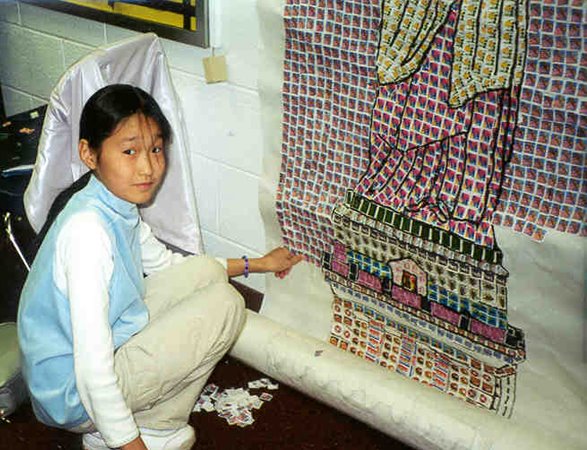
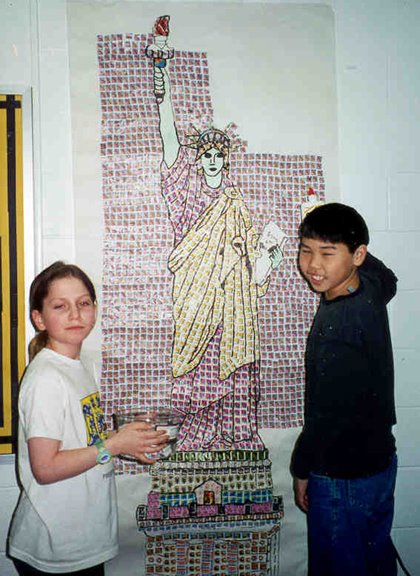
I wondered what other stamp mosaics may be on the web, and I found this photo gallery at the National Postal Museum. I have selected two images from this gallery for Ghost Town Orange. They feature my favorite postage stamp topic: the Statue of Liberty:


After me Mattheus was tortured; he named his house and the street in which we live, and said it was in a gate; however, I am of the opinion that there are no longer any gates on that street. Hence, move away altogether, if you have not done so yet; for I think the lord will find his way there. Let therefore no one who stands in any danger go into the house. He also named R. T.'s house, and the street where F. V. St. lives. Do herein immediately the best you can. He is very sorry for it.
--from the second letter of Christian Langedul to his wife, written while he was in prison in Antwerp, 12 August 1567

[The Bloody Theater; or Martyrs Mirror of the Defenseless Christians, compiled by Thieleman J. van Braght, 1660.]

Monday, January 09, 2006

Technical Difficulties

Technical difficulties over the weekend have delayed the 'Statue of Liberty on US Postage Stamps' post...

Also, I suddenly had a desire to see The Lion, the Witch, and the Wardrobe on the big screen; a movie where Santa Claus cheerfully passes out gifts of weapons to the young heroes, with the admonition that they are 'tools, not toys.' Odd that spiritual warfare is reduced to physical battle where the good guys never really die.

The redemptive death of the lion Aslan and his magical resurrection seems to reduce Jesus' death on the cross and resurrection to a magic trick. Why did Aslan's mane grow back? Shouldn't he bear the scars of the horrible death he just suffered?

I enjoyed reading the book as a child; re-reading it with one of my sons left me feeling frustrated at the shallowness of the story. Where is the church--the community of faith--in Aslan's army? Why are four flawed children shown as the only representatives of humanity in Narnia?

Forgive us, Lord God, if we have placed fun before fulfillment;
if we have sought pleasure before purpose;
if we have sought to leave a legacy that does not include love;
if we have viewed all of life as a competition;
if we have placed ourselves before others.
Pardon us, we pray, and help us to set straight our priorities.

Friday, January 06, 2006

Hitmap changed location

...and doesn't recognize Ghost Town Orange, so the Hitmap has been removed from the template.

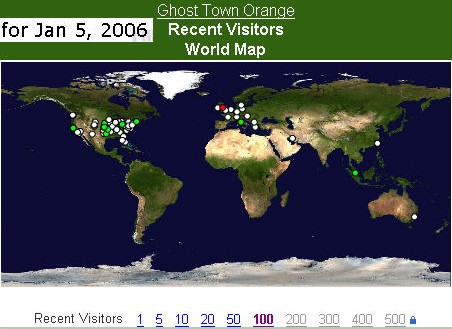
World map showing last 100 visitors to Ghost Town Orange
Fortunately, Sitemeter can show a map of the most recent visitors too.
The map is a fairly good representation of the English-speaking Web--prosperous parts of the world, with more access to the Internet.

Looking more closely at Sitemeter, I discovered that the post on the Statue of Liberty on Postage Stamps attracted visitors from Taiwan, the Netherlands, and Iran. It also was viewed by students in public schools in Illinois and Michigan, and by someone at usmc.mil! [Semper Fi!]

[A digression in honor of our Marine visitor: from what I've read [I hope it's not just propaganda] the Marines have done a much better job than the Army with winning hearts and minds in Iraq. I could be wrong, but have any Marines been implicated in torturing prisoners or shooting unarmed wounded enemies? This pacifist Christian thanks Marines [and all decent, human-rights observing American soldiers] for your service to our country--I condemn the misguided and evil civilian and military leaders [i.e. politicians and 'brass' at the Pentagon] who continue to put you in harm's way for no discernable purpose.]

In honor of this interest in the Statue of Liberty, Ghost Town Orange is preparing another big post about the Statue of Liberty on US postage stamps. I hope to post it on January 8 to commemorate the new rate change Statue of Liberty stamps.

A good thing about collecting the Statue of Liberty on US postage stamps is that most of these stamps are common, easy to find, and cheap. Everyone with an interest can have a 'complete collection' of them. The only exceptions are unused examples of the early 15 cent stamps. Ordinary letter postage was 2 cents--a 15 cent stamp would be the equivalent of a stamp costing $2.75 to $2.95 today. So not as many were used on mail; not as many were saved in unused condition. I'll have more to say about that Sunday afternoon.


In all our cares about worldly treasures, let us steadily bear in mind that riches possessed by children who do not truly serve God are likely to prove snares that more grieviously entangle them in that spirit of selfishness and exaltation which stands in opposition to real peace and happiness, and renders those who submit to the influence of it enemies to the cross of Christ.
--from the Yearly Meeting of the Society of Friends, held at Philadelphia in September 1759, quoted in John Woolman's journal.

Monday, January 02, 2006

More Statue of Liberty Postage Stamps

Click image for larger viewUSPS publicity image of the rate change stamp featuring the Statue of Liberty and the American Flag
Some of the most popular posts at Ghost Town Orange have been ones about the Statue of Liberty and postage stamps. For those new to Ghost Town Orange, here are a few posts that continue to attract visitors and may be worth a second look:
The new rate change postage stamps will add another page to my collection. The stamps will be available in a variety of formats: coil, panes, and booklets. The most difficult to find on mail will be the lick-'em-stick-'em gummed ones. Self-adhesive stamps are understandably more popular.

The US Postal Service will probably issue the same design denominated '39 cents.' So I will be checking my mail after January 8 to see how many different varieties I can identify.

In other Ghost Town Orange news, Sitemeter statistics report that recent visitors have come from the following countries:
  • 80% United States
  • 3% United Kingdom
  • 3% Germany
  • 3% Canada
  • 2% Netherlands
  • 1% Taiwan
  • 1% Islamic Republic of Iran
  • 1% Ireland
  • 1% Hungary
  • 1% Greece
  • 1% France
  • 1% Switzerland
  • 1% Bulgaria
  • 1% Australia
I have started stamp albums for many of these countries: United States, Germany, Canada, Netherlands, Greece, and France. It's only a matter of time until I add Hungary and Switzerland. My wife and sons have albums for Australia and the United Kingdom. Ghost Town Orange has not attracted many visitors from Latin America, but I collect several Latin American countries too. I'll probably never have a visitor from St. Pierre et Miquelon, but I collect stamps from there. My wife collects Israel, and one of my sons collects Arab Trucial States.

A little man in black, an officer of the Inquisition, who was sitting beside Pangloss, turned to him and politely said:

'It appears, Sir, that you do not believe in original sin; for if all is for the best, there can be no such thing as the fall of Man and eternal punishment.'

'I most humbly beg your Excellency's pardon,' replied Pangloss, still more politely, 'but I must point out that the fall of Man and eternal punishment enter, of Necessity, into the scheme of the best of all possible worlds.'

--Voltaire, Candide, or Optimism, 1759. [Translated by John Butt]

Sunday, January 01, 2006

Resolution

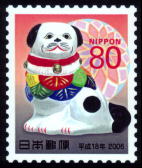
Akita dogSadowara clay doll 'dog'
Japanese New Year's Stamps for 2006
50 yen Akita dog postage stamp designed by Hoshiyama Ayaka
80 yen Sadowara clay doll 'dog' postage stamp designed by Kaifuchi Junko

I hereby resolve to update my blog frequently spend more time with my stamp collection in 2006.

A year ago, I purchased a nice lot of postally used stamps from Japan but I have not created an album for them yet. I print out pages from the CD-ROM disc I obtained from Stamp Albums Web. I'll be able to identify most of the stamps with the help of a used 1992 Scott catalog I recently found at a thrift store and the New Issues of Japan website for stamps after 1997. That may leave a big chunk of the 1990s a mystery unless I buy a more recent catalog.

Things to do at Ghost Town Orange:
  • Summer vacation series needs to be continued for another 2 1/2 weeks worth of entries.
  • Template needs to be tinkered with--why link to the NYT editorial writers who are behind the subscription wall?
  • The archive needs to be tested for dead links, missing pictures, etc.

The soul in this body has two principal impediments.

First, it is drawn into many activities and much agitation, and its different activities weaken and obstruct each other, for it is very hard to apply the mind to different things at the same time.

Secondly, the soul is engaged in inferior activites much earlier, more attentively, and more often than in higher ones, not only because of the condition of its abysmal dwelling but also because of the corporeal service assigned to men for a time by God. . .

But whenever the actions of eating, accumulating, feeling, or imagining either entirely cease or are greatly reduced, then the vision of the mind will be correspondingly sharpened, so that whatever is observed by the mind is observed more clearly under the power of this light.

--Marsilio Ficino [1433-1499], from Meditations on the Soul: Selected Letters of Marsilio Ficino, translated by members of the Language Department of the School of Economic Science, London.

Monday, March 14, 2005

Remembering Colonia Dignidad

Former Nazi Paul Schäfer, former leader of the cult-like Colonia Dignidad, has been arrested in Argentina and deported to Chile. He has a long history of running from the law:
A German Army nurse during World War II, Schaefer became the head of the Social Private Mission, a religious foundation in Siegburg, a town near Bonn, during the 1950s. The institution was a charitable organization ostensibly to provide education and healthcare for orphans.

When he fled Germany following pedophilia charges, up to 200 members of the Social Private Mission gradually followed him to Chile, where he became the head of a similar foundation and was known as their "Permanent Uncle."

Throughout the years, people who have managed to flee the colony and locals have pointed at Colonia Dignidad as a center of abduction, forced labor and sexual abuse (See Today’s Feature)[sorry, no link, subscription required], and Chile's failure to locate and arrest Schaefer since democracy was restored in 1990 has been a nagging issue to the center-left Concertacion alliance government.

After the 1973 coup in which Augusto Pinochet took power, the colonists began to forge links with the military and, according to the Valech Report, Colonia Dignidad became a "detention and torture center" used by the DINA and the CNI, the secret police of the military government.

But the strong protection net around Schaefer has always kept him clear of the courts, and residents at the colony have not admitted to tortures until recently. Peter Müller, the new leader of Villa Baviera, recognized Sunday that torture took place inside the colony.
[Irene Caselli in the Santiago Times, citing EL MERCURIO, LA TERCERA, LA NACIÓN [I do not know how to permanently link these stories--select the current Schäfer story and you'll find links to many more recent reports], and RADIO COOPERATIVA.]

And here is a link to Deutsche Welle's coverage of the story. Deutsche Welle's slowly-spoken German newscasts have been mentioning Colonia Dignidad and Paul Schäfer since Friday. I remember Nazi-watcher Mae Brussell [some would call her a conspiracy theorist] criticizing this group for torture and abductions in the mid-1980s. What does it mean when 'kooky conspiracy theorists' turn out to be right?

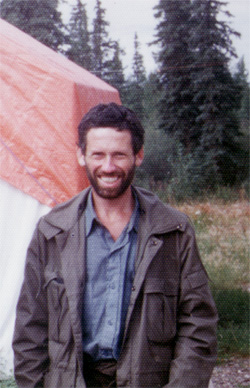
Among the thousands of people tortured and 'disappeared' by the Chilean government during Pinochet's reign was one American citizen-- Boris Weisfeiler:
There are more than 1,100 desaparecidos (disappeared persons) in Chile and one of them is a U.S. citizen - Boris Weisfeiler. A Russian-born mathematics professor at Pennsylvania State University, Weisfeiler vanished while on a hiking trip near the border between Chile and Argentina in the early part of January 1985. After a quick and cursory investigation, Chilean authorities concluded that Weisfeiler had drowned in the Nuble River during his trip.


Boris Weisfeiler vanished while on a hiking trip near the border between Chile and Argentina in the early part of January 1985.  Posted by Hello


Declassified U.S. documents tell a different story. According to an informant, Weisfeiler was detained by Augusto Pinochet's soldiers, presumed to be a Russian or Jewish spy, and taken to the mysterious German colony Colonia Dignidad. The declassified U.S. documents show that the U.S. Embassy personnel did not do enough to ascertain the fate of Weisfeiler, the only missing U.S. citizen in Chile. As consul Jayne Kobliska stated more than a year after Weisfeiler's disappearance in a memo from April 1986, "the real danger in this case is that we will delay action until it is too late to either save Weisfeiler's life or to determine the true circumstances of his death."
Yet another case of the US government co-operating with covering up Nazi crimes in the interest of fighting Communism.

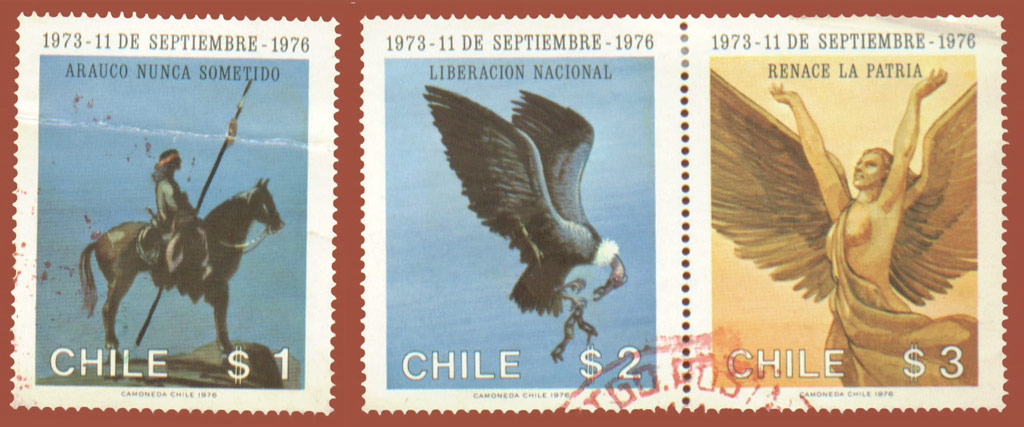
The Chilean government issued these stamps in 1976 to commemorate the third anniversary of the military coup that put Pinochet in power:

Another September 11 which lives in infamy. [I apologize for the poor condition of these stamps-definitely space fillers until I find better copies. Click for a larger image.] Posted by Hello

Note the Orwellian double-speak: a military dictatorship which jails, tortures and 'disappears' its opponents is glorified as breaking the chains of slavery and setting Chile free. [And what does that strange, nipple-less winged woman symbolize?]

This is a day of new beginnings,
time to remember and move on,
time to believe what love is bringing,
laying to rest the pain that's gone.

For by the life and death of Jesus,
God's mighty Spirit, now as then,
can make for us a world of difference,
as faith and hope are born again.

--Brian Wren
This is a day of new beginnings, 1978, alt.
(1st 2 verses)

Friday, January 28, 2005

Valentine memo to myself

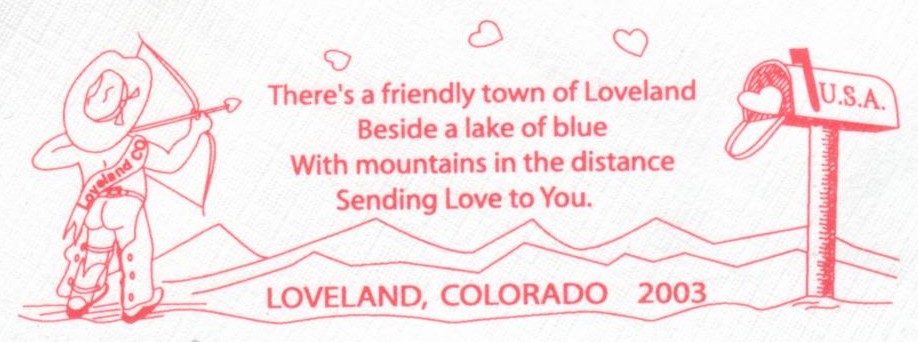
Remember to send a valentine to be re-mailed from Loveland, Colorado to my wife.

Instructions:
To have your valentines re-mailed, enclose your pre-stamped, pre-addressed Valentines with return address in a large 1st class envelope to:

Postmaster
Attn: Valentines
Loveland, CO 80538-9998


This is the 2003 Loveland Colorado Valentine cachet...what will this year's cachet look like? source Posted by Hello
About 50 volunteers work for the first 2 weeks of February processing about 300,000 valentines! Thank you for all that work! (I'll post a scan of the cachet and/or postmark when we receive it.)

This is a day of new beginnings,
time to remember and move on,
time to believe what love is bringing,
laying to rest the pain that's gone.

For by the life and death of Jesus,
God's mighty Spirit, now as then,
can make for us a world of difference,
as faith and hope are born again.

--Brian Wren
This is a day of new beginnings, 1978, alt.
(1st 2 verses)

Italian detective honored with new postage stamp

I am amused whenever conservative American stamp collectors complain about United States stamps portraying 'anti-Americans' or 'Communists.' (Recent examples include Mexican artist Frida Kahlo and African-American activist Malcolm X.)

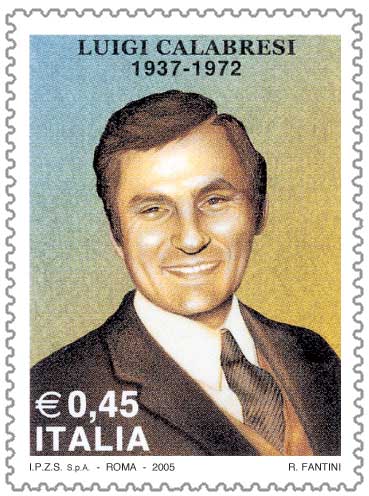
I wonder how liberal Italian stamp collectors feel about this: Luigi Calabresi is being honored with a new Italian postage stamp. [Gibbons Stamp Monthly]
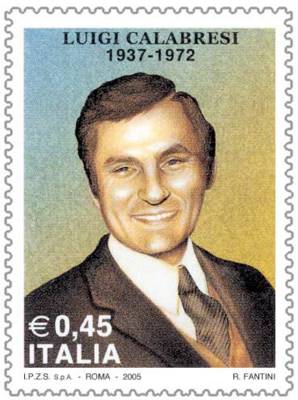
The Luigi Calabresi postage stamp.Source Posted by Hello


Pictorial First Day postmarks for the Luigi Calabresi postage stamp Posted by Hello

Read what right-wing Italian politicians have to say about him:
  • Interior Minister Giuseppe Pisanu
    the many Italians who will see the serene face of Luigi Calabresi on a stamp can read on it a lesson of civic dedication and pay homage to his heroic experience as a servant of the State, to a man whom we must not forget.
  • Communications Minister Maurizio Gasparri:
    a true Italian hero. [source: Gibbons Stamp Monthly]
Who was this heroic servant of the Italian State? He was the police official who was widely believed to be responsible for the death of anarchist Giuseppe Pino Pinelli in 1969. It seems that Italian intelligence and fascist army units were conducting terrorist bomb attacks and blaming them on anarchist groups. While in police custody, Pinelli "somehow" fell to his death out of the 4th floor window of Luigi Calabresi's office. [Calabresi was later cleared of any wrong-doing. Click here to read [in Italian] that Calabresi wasn't near his office when Pinelli was 'suicided.']

Less than 3 years later, Luigi Calabresi was assassinated by three extreme leftists, Adriano Sofri, Giorgio Pietrostefani, and Ovidio Bompressi. [source (scroll down)]

Now some Italian Communists think that if Calabresi is worth honoring with a postage stamp, perhaps a stamp honoring Pino Pinelli should also be issued [if I am reading the Italian correctly]:
Ora nessuno ha niente da dire sul francobollo per il commissario Calabresi. Noi sappiamo che Calabresi era un giovane commissario, dicono che fosse molto bravo, aveva moglie e tre bambini piccoli. Ha perso la vita da servitore dello Stato, ucciso ingiustamente e barbaramente da dissennati e fanatici terroristi: è questa è la motivazione per dedicargli un francobollo. Vorremmo però - lo diciamo senza polemica - che si dimostrasse la stessa sensibilità e riconoscenza per l'anarchico Pino Pinelli. Era un servitore dello Stato anche lui, faceva il ferroviere, lavorava sodo, faceva politica onestamente e con passione, senza ricompense e senza doppi fini, ed è stato ucciso ingiustamente dalla polizia. Non vi sembrerebbe giusto se lo Stato lo risarcisse, seppure con immenso ritardo e con un gesto simbolico infinitamente Piccolo, dedicando anche a lui un francobollo?
Here is a song dedicated to Pinelli:
Quella sera a Milano era caldo
ma che caldo, che caldo faceva,
"Brigadiere, apri un po' la finestra!",
una spinta ... e Pinelli va giú.

"Sor questore, io gliel'ho giá detto,
le ripeto che sono innocente,
anarchia non vuol dire bombe,
ma uguaglianza nella libertá".

"Poche storie, confessa, Pinelli,
il tuo amico Valpreda ha parlato,
é l'autore di questo attentato
ed il complice certo sei tu".

"Impossibile!", grida Pinelli,
"Un compagno non puó averlo fatto
e l'autore di questo delitto
fra i padroni bisogna cercar".

"Stai attento, indiziato Pinelli,
questa stanza é giá piena di fumo,
se tu insisti, apriam la finestra,
quattro piani son duri da far".

C'e' una bara e tremila compagni,
stringevamo le nostre bandiere,
quella sera l'abbiamo giurato,
non finisce di certo cosí.

E tu Guida, e tu Calabresi,
se un compagno é stato ammazzato,
per coprire una strage di Stato,
questa lotta piú dura sará.

Quella sera a Milano era caldo
ma che caldo, che caldo faceva,
"Brigadiere, apri un po' la finestra!",
una spinta ... e Pinelli va giú.
English translation, by Davide Turcato
That evening it was hot in Milan
how hot, how hot it was,
"Brigadiere, open the window!",
a push ... and Pinelli goes down.

"Mr. questor, I told you already,
I am repeating that I am innocent,
anarchy does not mean bombs,
but equality in liberty".

"No more humbug, confess, Pinelli,
your friend Valpreda talked,
he is the author of this bombing,
and you certainly are the accomplice".

"Impossible!", shouts Pinelli,
"A comrade couldn't possibly do that
and the author of this crime,
must be sought among the masters".

"Watch out, suspect Pinelli,
this room is already full of smoke,
if you persist, we'll open the window,
four floors are hard to do".

There's a coffin and 3,000 comrades,
we were clasping our flags,
that night we swore,
it won't end this way.

And you Guida, you Calabresi,
if a comrade was killed,
to cover a State slaughter,
this fight will just get harder.

That evening it was hot in Milan
how hot, how hot it was,
"Brigadiere, open the window!",
a push ... and Pinelli goes down.
[note: I may have to update this post if the accents do not show up properly, but I'm getting too tired to fix it tonight.]

UPDATE 29 JAN 8:25 AM

I have corrected the accents. I have no idea whether acute or grave accents are correct; I have kept them as they were in the original sources.

This is a day of new beginnings,
time to remember and move on,
time to believe what love is bringing,
laying to rest the pain that's gone.

For by the life and death of Jesus,
God's mighty Spirit, now as then,
can make for us a world of difference,
as faith and hope are born again.

--Brian Wren
This is a day of new beginnings, 1978, alt.
(1st 2 verses)

Stamp collecting--an avocation, not a passion

While in the library researching Upton Sinclair's 1934 campaign for governor of California, I ran across this on the "Topics of the Day" page of the August 25, 1934 Literary Digest:
Stamp-Collecting And an Old Story

Home-loving philatelists with a proper sense of proportion who believe that stamp-collecting may be fascinating enough, but that it has its place, were somewhat shocked to learn that one of the brethren recently "sold" his wife for $700. The $700 he used to buy more stamps.

Police uncovered this disturbing little drama in Hoboken, New Jersey, where, it seems, Richard Rost, postage-stamp dealer, and not much of a romanticist, turned over his wife, Hildegarde, thirty, and ten years her husband's junior, to a gentleman named Paul Herman, a stationary engineer. He first held out for $900, but Herman beat him down to $700. The three signed a legal document in a notary public's office, and all three were reported happy until Mr. Rost discovered, so he has charged, that his wife had stolen $175 worth of his stamps from him. It was this charge that landed all three in the county jail.

Mrs. Rost was bitter when her husband demanded that she return with him until the $175 was paid. She denied the charge that she had stolen the money and when Mr. Rost told her to go with him, she said, rather hysterically:

"I won't go back with you. I hate you! I hate you! You sold me!" Which, apparently, settled that, until Rost went around to the police and demanded satisfaction. The police then interviewed the neighbors and heard the story of the sale of Mrs. Rost.

All of which suggests that stamp-collecting may be more of an aid to domestic felicity as an avocation than as a passion.

This is a day of new beginnings,
time to remember and move on,
time to believe what love is bringing,
laying to rest the pain that's gone.

For by the life and death of Jesus,
God's mighty Spirit, now as then,
can make for us a world of difference,
as faith and hope are born again.

--Brian Wren
This is a day of new beginnings, 1978, alt.
(1st 2 verses)

Monday, January 10, 2005

Four or Five Corners of Luxembourg?

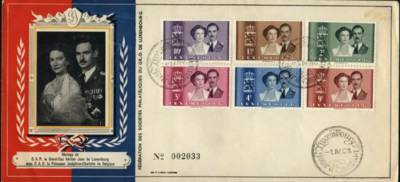
This morning the Grand Dutchess Joséphine-Charlotte of Luxembourg died. [story in French] She was the mother of the current Grand Duke Henri and the sister of Belgium's King Albert II. Here is a picture of a First Day Cover celebrating her marriage to Grand Duke Jean in 1953:

1953 First Day CoverPosted by Hello

The source of this picture is this website on Luxembourg Philately by Gary Little, which has pictures of almost all stamps ever issued by Luxembourg. (It hasn't been updated for about two years. For more recent stamps, go to the Luxembourg Posts and Telecommunications philately webpage.)

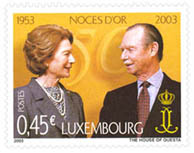
Here is a 2003 stamp celebrating the Golden Anniversary of the royal couple:

source: timbremania.lu Posted by Hello


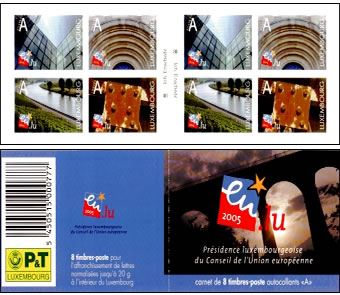
The Grand Duchy of Luxembourg is currently holding a 6-month term as president of the Council of the European Union. To celebrate, Luxembourg Post will issue a special booklet of stamps on January 25, 2005.

"The Colours of the Four Corners of Luxembourg" booklet  Posted by Hello


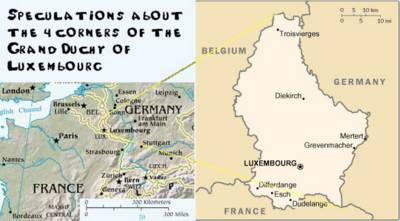
Since the booklet is entitled "The Colours of the Four Corners of Luxembourg," I wondered if Luxembourg has four corners. Is it shaped like Wyoming or Colorado? I surf over to the Perry-Castañeda Map Collection at the University of Texas to look at some CIA maps of Europe. Here is the Ghost Town Orange cut-and-paste where-is-Luxembourg-and-what-is-it-shaped-like? map:

The somewhat pentagonal shape of the Grand Duchy of Luxembourg. Posted by Hello

The Four Corners of Luxembourg, according to these stamps:


  1. The Capital, representing the services sector.

  2. Echternech basilica, representing small towns and villages.

  3. The Moselle, representing the countryside.

  4. Rust, representing the iron and steel industry in the southern part of the country.

UPDATE 7:37 pm CST

I noticed that accents and the n with tilde characters aren't showing up properly in my browser, so I used the table found here to find the correct number codes to use. I may place a link to this table on my sidebar...

This is a day of new beginnings,
time to remember and move on,
time to believe what love is bringing,
laying to rest the pain that's gone.

For by the life and death of Jesus,
God's mighty Spirit, now as then,
can make for us a world of difference,
as faith and hope are born again.

--Brian Wren
This is a day of new beginnings, 1978, alt.
(1st 2 verses)
Sunday, November 07, 2004

US Postal Service vs. Postal Service

Postal Service Tale: Indie Rock, Snail Mail and Trademark Law By BEN SISARIO [NYT]
About two and a half years ago, Jimmy Tamborello and Ben Gibbard began to make music together despite the distance between them. Mr. Tamborello, who makes electronica with a group called Dntel, lived in Los Angeles, while Mr. Gibbard, who sings in the emo band Death Cab for Cutie, lived in Seattle. They sent each other music through the mail, completing songs bit by bit, and after about five months, they had finished an album.

In honor of their working method they called themselves the Postal Service. Their album, "Give Up," was released by the Seattle-based Sub Pop Records in early 2003 and became an indie-rock hit, eventually selling almost 400,000 copies, the label's second biggest seller ever, after Nirvana's "Bleach."

Then they heard from the real Postal Service, in the form of a cease-and-desist letter.
Fast forward to the happy ending:
The outcome was as unusual as the band itself: this week the United States Postal Service - the real one, as in stamps and letters - signed an agreement with Sub Pop granting a free license to use the name in exchange for working to promote using the mail. Future copies of the album and the group's follow-up work will have a notice about the trademark, while the federal Postal Service will sell the band's CD's on its Web site, potentially earning a profit. The band may do some television commercials for the post office.

The group also agreed to perform at the postmaster general's annual National Executive Conference in Washington on Nov. 17. The attendees might not realize what a rare treat they are in for since the Postal Service does not play many gigs....
I like what I've heard of the Postal Service's music. And they like to use snail-mail!

Father, let me dedicate All this year to you
In whatever earthly state You will have me be
Not from sorrow, pain, or care Freedom dare I claim;
This alone shall be my prayer: Glorify Your name.
--from New Year's Hymn by Lawrence Tuttiett, 1864 (alt.)

Tuesday, October 12, 2004

The Annual Columbus Day Post

A post from last year revisited--
Let's remember what Christopher Columbus was really like:
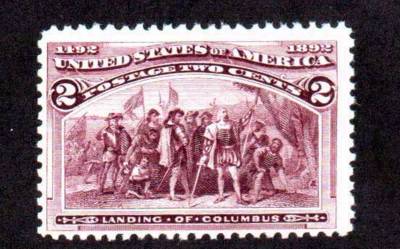
United States Postage Stamp, 1893--the Landing of Columbus
Landing of Columbus stamp, 1893 Posted by Hello

On his second voyage, at Hispaniola (the large island that is now Haiti and the Dominican Republic) Columbus and his men devised a system to extract gold from the native population:
Every man and woman, every boy or girl of fourteen or older, in the province of Cibao (of the imaginary gold fields) had to collect gold for the Spaniards. As their measure, the Spaniards used those same miserable hawk's bells, the little trinkets they had given away so freely when they first came 'as if from Heaven.' Every 3 months, every Indian had to bring to one of the forts a hawk's bell filled with gold dust. The chiefs had to bring in about ten times that amount. In the other provinces of Hispaniola, twenty-five pounds of spun cotton took the place of gold.

Copper tokens were manufactured, and when an Indian had brought his or her tribute to an armed post, he or she received such a token, stamped with the month, to be hung around the neck. With that they were safe for another three months while collecting more gold.

Whoever was caught without a token was killed by having his or her hands cut off. There are old Dutch prints (I saw them in the collection of Bishop Voegeli of Haiti) that show this being done: the Indians stumble away, staring with surprise at their arm stumps pulsing out blood.

There were no gold fields, and thus, once the Indians had handed in whatever they still had in gold ornaments, their only hope was to work all day in the streams, washing out gold dust from the pebbles. It was an impossible task, but those Indians who tried to flee into the mountains were systematically hunted down with dogs and killed, to set an example for the others to keep trying.
Resistance was futile: "It was at this time that the mass suicides began: the Arawaks killed themselves with cassava poison." --from Columbus: his Enterprise; Exploding the Myth by Hans Koning, based on the reports by Bartolome de las Casas.

Perhaps you think we should not judge Columbus by the standards of today--surely in the light of the 15th century he was a great and noble hero!

Apparently there were plenty of men of that distant and benighted age that criticized Columbus and the Spanish misbehavior in the Americas; among them are Bartolome de las Casas, Antonio de Montesino, Fray Buil, Pedro Margarit, and the Dutch etcher DeBry. So do not believe the lie that plundering, raping and massacring people was somehow considered acceptable behavior in the past. It wasn't.

Even Samuel Eliot Morison, in Christopher Columbus, Mariner an otherwise quite positive portrayal of the hero Columbus admits that "the cruel policy initiated by Columbus and pursued by his successors resulted in complete genocide."

I have recently been reading A View of the Causes and Consequences of the American Revolution; in Thirteen Discourses, Preached in North America between the Years 1763 and 1775: with an historical preface by Jonathan Boucher, apparently an Anglican minister that returned to England after the outbreak of the American Revolution. The first sermon, "On the Peace in 1763" includes this reminder of what true greatness is:
True greatness deserves all the honour that the world can pay to it: but, fields dyed with blood are not the scenes in which true greatness is most likely to be found. He who simplifies a mechanical process, who supplies us with a new convenience or comfort, or even he who contrives an elegant superfluity, is, in every proper sense of the phrase, a more useful man than any of those masters in the art of destruction, who, to the shame of the world, have hitherto monopolized almost all its honours.
Amen.

Father, let me dedicate All this year to you
In whatever earthly state You will have me be
Not from sorrow, pain, or care Freedom dare I claim;
This alone shall be my prayer: Glorify Your name.
--from New Year's Hymn by Lawrence Tuttiett, 1864 (alt.)

Wednesday, August 18, 2004

Personalized US postage stamps soon to be available

Via Yahoo News: Stamps.com Offers Personal Photos on U.S. Postage
Wed Aug 11, 7:21 PM ET

NEW YORK (Reuters) - Bad sunsets, cutesy baby pictures, and dogs, lots of dogs, will feature in a new line of U.S. stamps introduced this week by Web-based Stamps.com, which turns digital photos into valid postage.

Stamps.com Inc. said it had won approval from the U.S. Postal Service for a trial run of personalized postage that allows consumers to slap their favorite photos on officially recognized stamps for postcards, letters and packages.
Here is the link to order Stamps.com's personalized stamps. The drawbacks: It will cost $16.99 to order 20 37-cent stamps. You aren't allowed to use anything controversial--no political candidates allowed, for example.

Well, I'm off to design a set of stamps. Watch Ghost Town Orange to see what I come up with...

Father, let me dedicate All this year to you
In whatever earthly state You will have me be
Not from sorrow, pain, or care Freedom dare I claim;
This alone shall be my prayer: Glorify Your name.
--from New Year's Hymn by Lawrence Tuttiett, 1864 (alt.)

Stamp album as a universal book?

I enjoy reading wood s lot several times a week. Yesterday the author Bruno Schulz was commemorated, including this excerpt from the story Sanatorium Under the Sign of the Hourglass:
Bianca, enchanting Bianca, is a mystery to me. I study her with obstinacy, passion and despair - with the stamp album as my textbook. Why am I doing this? Can a stamp album serve as a textbook of psychology? What a naive question! A stamp album is a universal book, a compendium of knowledge about everything human. Naturally, only by allusion, implication, and hint. You need some perspicacity, some courage of the heart, some imagination in order to find the fiery thread that runs through the pages of the book.

One thing must be avoided at all costs: narrow-mindedness, pedantry, dull pettiness. Most things are interconnected, most threads lead to the same reel. Have you ever noticed swallows rising in flocks from between the lines of certain books, whole stanzas of quivering pointed swallows? One should read the flight of these birds ...
[source: this page]

People are able to extract meaning from all sorts of random noise--why not stamp albums? I wish I knew more about the stamp album mentioned in this story. Is it Bianca's or the narrator's? Is it a pre-printed album [like my Modern Postage Stamp Album of 1930] or is it a collection of homemade pages? At the time the story was written [1930s], postage stamps weren't nearly as varied as they are today. I wonder what Bruno Schulz would think of postage stamps today.

Father, let me dedicate All this year to you
In whatever earthly state You will have me be
Not from sorrow, pain, or care Freedom dare I claim;
This alone shall be my prayer: Glorify Your name.
--from New Year's Hymn by Lawrence Tuttiett, 1864 (alt.)

Saturday, August 14, 2004

Busy-ness

We have been busy around Ghost Town Orange; but cobwebs have been accumulating at the blog--no posts in 10 days...Here's what we've been up to:
  • Book donations
    The 'friend of the library' book sale has been the excuse we needed to start organizing and weeding our books.
  • Cataloging books
    I am creating a database of our books. I use the Library of Congress Cataloging-in-Publication Data [if available] or I look up the info at the Library of Congress Catalog. About 1/3 of our books (not counting the boys' books!) have been cataloged--about 650 books so far. [Over 50 cookbooks! What are we going to do with them all?] About 1/3 of the books are on the shelves and still uncataloged, and the final third are still boxed up in the garage.
  • Peach harvest
    Of course, they all seem to ripen at the same time, and our tree has been thriving in this beautiful weather: no extreme heat this summer, and more rain than average. We have been freezing what we can't eat.
  • Ford donation
    The old Ford was violating a city ordnance [naughty car] by not moving every 24 hours. So we gave it away. According to the True Market Value appraiser at Edmunds.com, the Ford was worth $123 as a trade-in; could sell for $267 as a private party sale, and would cost $531 at a crooked car dealer.
  • Australia stamp album
    Our next stamp club meeting will feature the first Australian air mail stamp. Tim already collects Australia, and has an album. I printed out pages to make Joyce an album. The best investment in stamp collecting I have ever made was buying the CD-ROM of printable album pages available at Bill Steiner's Stamp Album Website. [On-line membership is also available.]
  • Back to school supply shopping
    When I was in elementary school, I don't remember scrambling every year to get school supplies. But that was back in pre-Proposition 13 California. On the first day of school, my desk would already be stocked with pencils, crayons, glue, scissors, paper, etc. Here in Oklahoma, parents are expected to provide all of this and more, including multiple boxes of Kleenex tissue!!???


Blogger ate my first version of this post. Grrr.

Father, let me dedicate All this year to you
In whatever earthly state You will have me be
Not from sorrow, pain, or care Freedom dare I claim;
This alone shall be my prayer: Glorify Your name.
--from New Year's Hymn by Lawrence Tuttiett, 1864 (alt.)

Saturday, July 24, 2004

New Old Bridge at Mostar, Bosnia

From the New York Times: Bridge Is Restored in Bosnia, and With It Hope of Peace


Tom Dubravec/European Pressphoto Agency Posted by Hello

By RICHARD BERNSTEIN
Published: July 24, 2004:
MOSTAR, Bosnia and Herzegovina, July 23 - With music, dance, colored lights and speeches about reconciliation and a better future, this afflicted Balkan town formally reopened on Friday the famous and historic bridge that was obliterated a decade ago during the fighting in the former Yugoslavia.

It was not really the old bridge of Mostar that was reopened. The original bridge was built in 1566 under the Ottoman Turks and celebrated during the 427 years of its existence for the grace of its arched 95-foot span. What has been completed is a painstakingly faithful, stone-by-stone replica of that bridge, destroyed on Nov. 9, 1993, by a Croatian bombardment that has since stood as an emblematic act of the senselessness of the long Bosnian madness.

But the new ancient bridge of Mostar, a picturesque mountain town of about 120,000 people that was one of the deadliest battlegrounds of the conflict, nonetheless emerged Friday as a metaphor for revival, or, if not revival yet, at least the durability for almost a decade now of something resembling ethnic peace.

"The opening of the old bridge in Mostar is a victory of peace," Sulejman Tihic, the head of the collective presidency of Bosnia-Herzegovina, said in a speech on this sun-baked Friday afternoon, "a victory for Bosnia as a multiethnic and multicultural society."

[snip]

The destruction of the bridge was so senseless because it was used by all sides. In the view of local people, it was obliterated for its fame and beauty, for its status as a treasure of Ottoman and Muslim architecture.

The bridge in this sense reopened at a time when, clearly, conditions are better for Mostar and for Bosnia and Herzegovina as a whole, but it would be difficult all the same to describe them as good. Symbolizing the general improvement, the Croatian commander who ordered the bridge bombed, Slobodan Praljak, is in The Hague awaiting trial for war crimes, along with others accused of instigating and perpetrating the Balkan slaughter of 1992 to 1995.

[snip]

And then there was the bridge itself - all 1,228 stones of it, including 140 of the original pieces retrieved from the river and put back in their original places. It stands over a narrow, rippling portion of the river, its high span, commonly likened to an arrow pointing to the sky, gleaming a bit too newly, needing a bit of the patina of age. It looks like a slightly whitened reincarnation of the old bridge, as seen on picture postcards, paintings and the beaten copper plaques available in the local tourist shops.

The Neretva River was lined on both sides by ancient stone buildings, some restored, others still in ruins. The minarets of mosques and church steeples, those twin symbols of Mostar's multiethnicity, stood on the horizon, also on both banks.
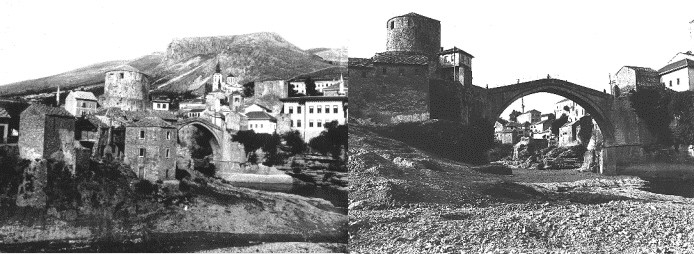
Here are some views of the old bridge:

source [my stitching] Posted by Hello


Some Bosnian stamps featuring the Old Bridge at Mostar (from 1906):

source [my stitching] Posted by Hello

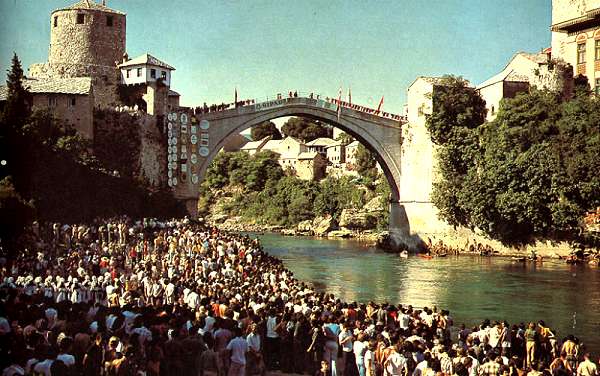
Another picture of the old bridge:

Annual diving contests were held at the Old Bridge.
source Posted by Hello

History of Stari Most, found at www.domovina.net

Mostar's most famous landmark became a single-arch stone bridge over the Neretva River. It was designed in 1566 by the Turkish architect Mimar Hairedin, who studied under the greatest of all Ottoman architects, Sinan. The bridge was a masterpiece of Ottoman baroque architecture, and is one of the most beautiful bridges in the world. Known as the "Old Bridge" or "Stari Most", it is the city's namesake.

[snip]

For Bosnia's Muslims, raising the "Old Bridge" is an act as deeply symbolic as its destruction. However, putting Bosnia-Herzegovina back together will take more than rebuilding a bridge. In Mostar, Croats have shown little willingness to reunite the city, remaining stubbornly separate from Muslims.

Since the war, organized crime is on the rise. The anarchy of war can provide new opportunities for criminals to thrive and profit. In Mostar men who were in and out of prison before the war now drive through the city streets in modern cars and sedans. They have little use for peace agreements or the return of law.

Mostar had a population of 130,000 before the war. The devastating fighting left approximately 60,000 people, split between Muslim and Croat. From the devastation of shelling a few short years ago, the good life is starting to re-emerge in Mostar, shops are opening with displays of Levis and Italian shirts. An ABC Sweet Shop is open, located in the old town. The situation is improving slowly as some factories reopen and start to hire people. The city's previous economy was based on textile, tobacco, food-processing and bauxite mining and all these industries have survived.

On the west side of the Neretva River, cafes, boutiques and restaurants are in abundance as well as two discos full of young people. Remarkably, in some places in Mostar it is now possible to believe there never was a war. More and more people are beginning to cross the border of hate.

The western bank of the Neretva River is the modern, predominately Croatian side of the city. During the war, after uniting to fight off the Serbs, the Muslims and Croats turned their guns on each other. The western portion of the city Croat area, was not as severely damaged as the eastern bank of the Neretva River in which Muslims predominate.
Links:
  1. RealVideo links [source]:
  2. Many pictures of the new Old Bridge
  3. Mostar webcam
  4. Re-opening ceremony program (Mostar city site)
  5. big website on Mostar by John Kozlich

John Kozlich's site on Mostar contains some coverage of the re-opening of the bridge:
In a city long an emblem for the bigotry and apartheid blighting Bosnia, Milan Milesovic this week struck a small blow for decency and common sense. On Sunday evening, the ambulance driver from the Croat west side of a city divided ethnically for 10 years switched on his flashing blue lights and raced across the bridges over the Neretva river to respond to the emergency call of a sick Muslim on the other side. "I am just doing my job. It's normal," Mr Milesovic shrugged.

But in a town where the takeaway pizza joint will not deliver to the Muslims across the river, where Croats and Muslims can be identified by their different mobile phone numbers and servers, where education from kindergarten to university is strictly segregated, and where you still cannot take a city bus across the old frontline from the Bosnian war, the ambulance driver's mission of mercy was anything but normal.

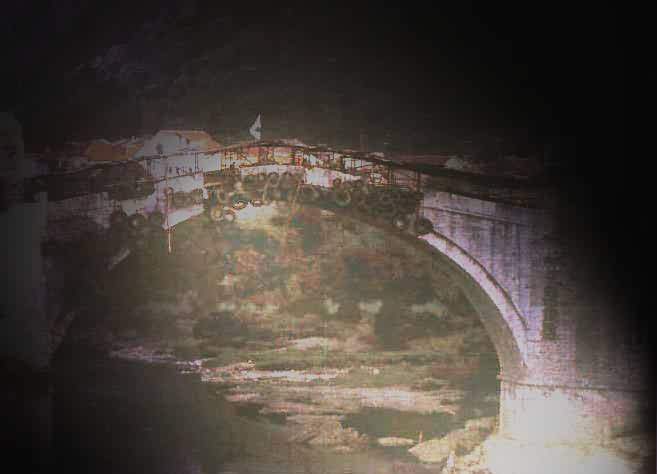
Here is a photo from Mr. Kozlich's website, showing how Mostar residents attempted to save the Old Bridge from Croatian shelling:

The Old Bridge festooned with old automobile tires. Source. Posted by Hello

A historic city clings to the hope of survival. The "Old Bridge", festooned with old automobile tires in a gallant attempt to protect it from the ravages of shell and mortar fire, stood in testimony to the most fervent hope of the trapped citizens of the shattered town of "MOSTAR" - that somehow the gap between war and peace can be bridged and life allowed to resume again.
Mr. Kozlich's site is a bit misleading about the re-construction of the Old Bridge--very few pieces of the original bridge were able to be used in the re-construction. For more on the engineering of the bridge restoration project, spend a few hours browsing the Stari Most website of General Engineering of Florence, Italy. It has wonderful detailed drawings and descriptions of all aspects of the project--and I mean all aspects. Here is part of an interview with a member of General Engineering's team:
Journalist - Will those portions be composed by the same ancient stones of the former structure ?

Mr.Romeo - No, no way… We have to understand that with war something has been definitely lost and it will not be possible to recover it. At the very beginning of this assignment everybody involved in this ambitious project was thinking and hoping to have the technical possibility to rebuild the bridge following a sort of anastilosis technique…

Journalist - what do you mean by "anastilosis technique" ?

Mr.Romeo - You perform an anastilosis reassembling when you remount single destroyed elements of a small portion of a monument in the original locations trough the help of wide and reliable documentation and by declaring the portions that underwent to these peculiar procedure in respect of the original ones. This way the integrity of the monument is preserved with its historical value, but those portions will have a lower relevance. Of course this is generally possible only if applied in small portions of the whole structure: it was not the case of the Old Bridge of course.

Journalist - Why wasn't it possible to proceed this way also for the Bridge ? was this only a matter of quantities and percentage of portion of the monument that was blown in to pieces ?

Mr.Romeo - Not exactly: it was the small quantity of recovered stones from the river: think that, counting also those stone blocks still on site next to the abutments wall, we could reposition in the original location not more than 22% of the global amount. But this was an optimistic evaluation since many of these stones were fractured in the inner portions and moreover most of the voussoir, (arch stones), were assembled in big blocks trough the ancient anchoring system. This would have required to disassemble those stones with a procedure that might have provoked further damages to the stones and the definite loss of the examples of the ancient refined assembling technique used at the time. In other words even in the case that technical issues could be faced, there were so little stone of the former bridge available, that we would have gained a new bridge with some stones of the old one inserted as spots. It was decided that this was not acceptable.

Journalist - This is really disappointing… but how is it possible that so many stones have been lost ?

Mr.Romeo - I have no precise idea… but as far as I'm concerned, I can say that trough careful examination of the video documentation of the destruction of the bridge it was clear that a large amount of the stones of the bridge were reduced to powder due to multiple direct hits of the shelling. Moreover I think that if you take a stone and let it fell down from an height of 20 meters together with other stones and over the rocks in the bottom of the river… then I presume that you might find many small fragments and a few preserved blocks…

Journalist - Therefore the bridge will be a new bridge ?

Mr.Romeo - Yes, we can call it "the new Old Bridge"

Journalist - How can this bridge have the same value and same symbolical meaning of the former one?

Mr.Romeo - It will not have the same value, nor the same symbolical meaning, and it couldn't be otherwise. The destruction of the bridge is now part of our history and it would be simply an utopia to cancel it. The new old bridge will be spanning over the Neretva and everybody will know that this is a copy of the former one: there will be different declarations devices in order to show the limit from which the new structure starts, and this will be also the way to remember tragic war events trough the observation of this bridge that will restore the global view of the monumental complex, the memory, the cultural identity and the symbol of the people. But for sure we can not, and we should not, consider it the same old bridge.

Father, let me dedicate All this year to you
In whatever earthly state You will have me be
Not from sorrow, pain, or care Freedom dare I claim;
This alone shall be my prayer: Glorify Your name.
--from New Year's Hymn by Lawrence Tuttiett, 1864 (alt.)

Friday, July 23, 2004

Criticism of the Post Office is not new

Issued at Project Gutenberg today: America To-day, Observations and Reflections by William Archer. Here is what Mr. Archer said about New York's postal services in 1899:
In one of the essential conveniences of modern life, New York is far behind London; but the blame lies, not with the city, but with the United States. Its postal arrangements are at best erratic, at worst miserable. Letters which would be delivered in London in three or four hours take in New York anywhere from six to sixteen hours. It was a long time before I realised and learned to allow for the slowness of the postal service. At first I used mentally to accuse my correspondents of great dilatoriness in attending to notes that called for an immediate reply. On one occasion I posted in Madison Square at 3 P.M. a letter addressed to the Lyceum Theatre, not a quarter of a mile away, suggesting an appointment for the same evening after the play. The appointment was not kept, for the letter was not delivered till the following morning! To ensure its delivery the same evening, I ought to have put a special-delivery stamp on it--price fivepence--in addition to the ordinary two-cent stamp. No doubt it is the universal employment of the telephone in American cities that leads people to put up with such defective postal arrangements.

But it is not only within city limits that the United States Post Office functions with a dignified deliberation. The ordinary time that it takes to write (say) from New York to Chicago, and receive an answer, might be considerably reduced without any acceleration of the train service. It sounds incredible, but it is, I believe, the case, that the simple and eminently time-saving device of a letter-box in the domestic front-door is practically unknown in America. I did observe one, in Boston, so small that a fair sized business letter would certainly have stuck in its throat. One evening I was sitting at dinner in a fashionable street in New York, close to Central Park, when I was startled by a distinctly burglarious noise at the window. My host smiled at my look of bewilderment, and explained that it was only the letter-carrier; and, sure enough, when the servant came into the room she picked up three or four letters from the floor. The postman was somehow able to reach the front window from the "stoop," open it, and throw in the evening's mail--a primitive arrangement, more suggestive of the English than of the American Gotham. Even the gum on the United States postage-stamps is apt to be ineffectual. When you are stamping letters in hot haste to catch the European mail, you are as likely as not to find that the head of President Grant has curled up and refuses--most uncharacteristically--to stick to its post.
Emphasis added. Once upon a time, large cities had multiple mail deliveries every day. Typical of a Brit to expect a flock of messengers to deliver his urgent missives when telephones are available.

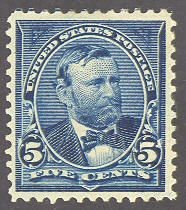
The fee for special delivery in 1899 was 10 American cents--five times the postage for a letter. Mr. Archer mentions a postage stamp portraying President Grant. It probably was the 5 cent dark blue of the Bureau [of Engraving and Printing] issue of 1898, which paid the postage for the international letter rate. So this would be the stamp Mr. Archer used to write to his friends back in Great Britain:

United States #281: found at zillions of stamps Posted by Hello

1898 was the year the United States Post Office changed the color of stamps to meet the requirements of the Universal Postal Union. Earlier 5 cent Grant stamps were chocolate brown.


Father, let me dedicate All this year to you
In whatever earthly state You will have me be
Not from sorrow, pain, or care Freedom dare I claim;
This alone shall be my prayer: Glorify Your name.
--from New Year's Hymn by Lawrence Tuttiett, 1864 (alt.)

Wednesday, July 21, 2004

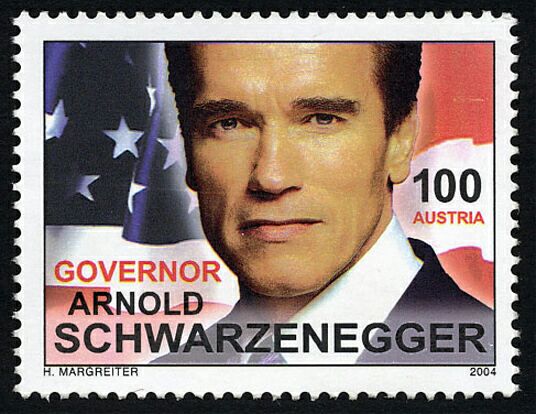
Girly Man gets a stamp


Source: Austria Post Posted by Hello

Reuters has the story:
VIENNA (Reuters) - Austrian fans of their famous compatriot Arnold Schwarzenegger will be able to lick the back of the California Governor when his image appears on a special edition of postage stamps at the end of this month.

The former bodybuilder and film star chose the portrait of himself that will be used on one-euro stamps to be issued in Austria on his 57th birthday, July 30, a postal service spokesman said on Friday.


Here is a link to Austria Post's page on the Schwarzenegger stamp.


Father, let me dedicate All this year to you
In whatever earthly state You will have me be
Not from sorrow, pain, or care Freedom dare I claim;
This alone shall be my prayer: Glorify Your name.
--from New Year's Hymn by Lawrence Tuttiett, 1864 (alt.)