Showing posts with label Violence. Show all posts

Sunday, January 22, 2006

On Generation X

Although I was born at the end of the baby boom, I've always identified more with 'Generation X'--the children of television, divorce, and downward mobility.

Here are some notes from an old notebook. Alas, I did not record the source of these observations...
I don't buy things--especially if they're advertised.--Scott Lamorte

'It's the self-consciously minimalist lifestyle of the Lamorte brand of Xers, combined with the involuntary poverty of the rest, that has Madison Avenue biting its nails.

After tenderly ministering to every whim of the boomers' evolving buying frenzy--usually to the exclusion of everyone else--the marketing types are beginning to realize that their next target may not be such an easy sell. How do you appeal to a generation that sees the boomers' conspicuous consumption as one of the main roots of its own plight?'

Conformity to Christ necessarily implies nonconformity to the world. True faith in Christ means willingness to do the will of God, rather than willful pursuit of individual happiness. True faith means seeking first the reign of God in simplicity, rather than pursuing materialism. True faith means acting in peace and justice, rather than with violence or military means.
--From Article 17, Discipleship and the Christian Life
Confession of Faith in a Mennonite Perspective, 1995

Tuesday, January 03, 2006

Overcome evil with good

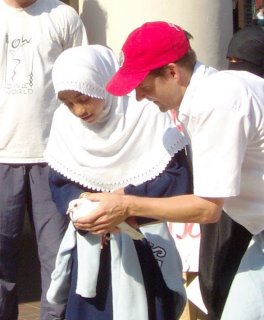
CPT photo of Jim Loney passing a peace dove to a friend for release at a multi-faith walk for the release of Iraqi captives
Christian Peacemaker Teams--committed to reducing violence by getting in the way.

What would happen if Christians devoted the same discipline and self-sacrifice to nonviolent peacemaking that armies devote to war?

CPT photo: Jim Loney passes off a peace dove to a friend for release at a multi-faith walk for the release of Iraqi captives.

[found here: Missing in Iraq: Pictures Related to the Developing Crisis]


You must guard aginst further indulging in hateful thoughts and feelings--even repressed ones--and pray for good for those who hurt or oppose you. You see examples of what can happen to a soul who did not restrain feelings of hate and vengeance. Not a pretty sight, is it? Hatred and ill will are never pretty when fully unmasked. The pleasure you derive in them cannot be compared to the joy you will have when you put them away.
--Hal M. Helms, Echoes of Eternity: Listening to the Father, 1996

Tuesday, August 16, 2005

On Situational Libertarianism

As a long-time left-libertarian, I am amazed at how many right-wing libertarians are really statists at heart. For example, read Charles Krauthammer's recent article Situational libertarianism [at Townhall.com]
Call it situational libertarianism: Liberties should be as unlimited as possible -- unless and until there arises a real threat to the open society.
[Who determines the reality of the threat? The government, of course.]

Mr. Krauthammer goes on to praise British Prime Minister Tony Blair:
Britain is just now waking up, post-7/7. Well, at least its prime minister is. His dramatic announcement that Britain will curtail its pathological openness to those who would destroy it -- by outlawing the fostering of hatred and incitement of violence and expelling those engaged in such offenses -- was not universally welcomed.

His own wife had made a speech a week after the second London bombings loftily warning against restricting civil liberties. "It is all too easy to respond in a way that undermines commitment to our most deeply held values and convictions and cheapens our right to call ourselves a civilized nation,'' declared Cherie Blair. You need only read Tony Blair's 12-point program to appreciate how absurd was his wife's defense of Britain's pre-7/7 civil liberties status quo.
To which Lew Rockwell and/or Kurt Kober respond: [at LewRockwell.com Blog]
Hey Chuck, how about if I call it situational fascism?
Point 11 of Mr. Blair's plan:
Eleven, we will consult on a new power to order closure of a place of worship which is used as a centre for fomenting extremism, and will consult with Muslim leaders in respect of those clerics who are not British citizens to draw up a list of those not suitable to preach and who will be excluded from our country in future.
How would Christians feel if the American government gave itself a new power to close churches that foment extremism? How would we feel if churches were forced by the Federal Government to consult a list of those not suitable to preach before calling a pastor?

Situational freedom is not freedom at all.

But American right-wingers can rest easy. The Fred Phelps-style 'God-hates-fags' churches are safe; the historic peace churches and mainline churches that oppose 'wars of choice' are more likely targets of government bans. After all, those that criticize the 'war on terror' support terrorists, don't they?

God our security,
who alone can defend us
against the principalities and powers
that rule this present age;
may we trust in no weapons
except the whole armor of faith,
that in dying we may live,
and, having nothing, we may own the world,
through Jesus Christ. AMEN
--Janet Morley, All desires known, 1988

Monday, January 17, 2005

News Flash: Iraq a breeding ground for terrorists, replacing Afghanistan

Now it's official: a new CIA National Intelligence Council report concludes that Iraq New Terror Breeding Ground/War Created Haven [Washington Post, registration required]:
Iraq has replaced Afghanistan as the training ground for the next generation of "professionalized" terrorists, according to a report released yesterday by the National Intelligence Council, the CIA director's think tank.

Iraq provides terrorists with "a training ground, a recruitment ground, the opportunity for enhancing technical skills," said David B. Low, the national intelligence officer for transnational threats. "There is even, under the best scenario, over time, the likelihood that some of the jihadists who are not killed there will, in a sense, go home, wherever home is, and will therefore disperse to various other countries."

Low's comments came during a rare briefing by the council on its new report on long-term global trends. It took a year to produce and includes the analysis of 1,000 U.S. and foreign experts. Within the 119-page report is an evaluation of Iraq's new role as a breeding ground for Islamic terrorists.

[snip]
The report, titled "Mapping the Global Future " [link PDF, 6.69MB], highlights the effects of globalization and other economic and social trends. But NIC officials said their greatest concern remains the possibility that terrorists may acquire biological weapons and, although less likely, a nuclear device.

Here is a link to the part of the report that deals with terrorism. The relevant portion:
The core al-Qa'ida membership probably will continue to dwindle, but other groups inspired by al-Qa'ida, regionally based groups, and individuals labeled simply as jihadists--united by a common hatred of moderate regimes and the West--are likely to conduct terrorist attacks. The al-Qa'ida membership that was distinguished by having trained in Afghanistan will gradually dissipate, to be replaced in part by the dispersion of the experienced survivors of the conflict in Iraq. We expect that by 2020 al-Qa'ida will have been superceded by similarly inspired but more diffuse Islamic extremist groups, all of which will oppose the spread of many aspects of globalization into traditional Islamic societies.

* Iraq and other possible conflicts in the future could provide recruitment, training grounds, technical skills and language proficiency for a new class of terrorists who are "professionalized" and for whom political violence becomes an end in itself.

* Foreign jihadists--individuals ready to fight anywhere they believe Muslim lands are under attack by what they see as "infidel invaders"--enjoy a growing sense of support from Muslims who are not necessarily supporters of terrorism.

Of course, the true believers among the neo-cons will dismiss the CIA as a nest of 'liberals' that are really soft on terrorism.

This is a day of new beginnings,
time to remember and move on,
time to believe what love is bringing,
laying to rest the pain that's gone.

For by the life and death of Jesus,
God's mighty Spirit, now as then,
can make for us a world of difference,
as faith and hope are born again.

--Brian Wren
This is a day of new beginnings, 1978, alt.
(1st 2 verses)

Saturday, November 13, 2004

Iris Chang 1968-2004

From the New York Times obituary (no permanent link available):
Iris Chang, a journalist whose best-selling book, "The Rape of Nanking," a chronicle of the atrocities committed in that city by occupying Japanese forces, helped break a six-decade-long international silence on the subject, committed suicide on Tuesday near Los Gatos, Calif.
"I wanted to show the people that the Japanese soldiers were inculcated to commit violence. This is not a story that was an isolated incident." --Iris Chang on the Rape of Nanking.

Here is a link to the transcript of CSPAN's Booknotes interview with Iris Chang (January 11, 1998) about The Rape of Nanking: The Forgotten Holocaust of World War II:
What I learned was that the Japanese soldier really had to see the Chinese as subhuman before they could kill them. I mean, he--he depicted the--the Chinese in his diary as--you know, as like animals or as insects.
More links here:

Apparently the Japanese would rather not know about their own history: the planned Japanese edition of The Rape of Nanking was never published due to 'conservative' pressure. Go here for an example of Japanese revisionism. According to Timothy M. Kelly, Ms. Chang was a sloppy historian [remember that she was not a historian, but a journalist by training--that may explain some of her errors].

Father, let me dedicate All this year to you
In whatever earthly state You will have me be
Not from sorrow, pain, or care Freedom dare I claim;
This alone shall be my prayer: Glorify Your name.
--from New Year's Hymn by Lawrence Tuttiett, 1864 (alt.)

Friday, July 16, 2004

Eureka Stockade: Australian Postage Stamps

Australia Post has recently issued stamps commemorating the 150th anniversary of the Eureka Stockade--a rebellion at the Ballarat gold mines in Victoria.

Image source: WADP Numbering System [2 images stitched together.] Click image to enlarge.
The $2.45 stamp uses an image of Peter Lalor, the man who led the diggers at the stockade. The 50c stamp features a representation of the Eureka flag, which at the time was called the flag of the Southern Cross.
The stamp to the left includes part of this painting in the background [I notice that the flag pole was shortened to make the flag fit better on the stamp]:

Gold miners swearing allegience to the 'Southern Cross' on 30 November, 1854. Painting by Charles Doudiet, a participant in the rebellion. [Ballarat Fine Art Gallery] Posted by Hello
Some five hundred armed diggers advanced in real sober earnestness, the captains of each division making the military salute to Lalor, who now knelt down, the head uncovered, and with the right hand pointing to the standard exclaimed in a firm, measured tone: -

"WE SWEAR BY THE SOUTHERN CROSS TO STAND TRULY BY EACH OTHER, AND FIGHT TO DEFEND OUR RIGHTS AND LIBERTIES."

An universal well rounded AMEN was the determined reply; some five hundred right hands stretched towards our flag."
[quote from Raffaello Carboni's book, The Eureka Stockade. (see link at Project Gutenberg below)]

Here is a link to the Archives of the Eureka Stockade.

The State Library of Victoria has pages devoted to the Australian gold fields in general and to the Eureka Stockade in particular.

Project Gutenberg has a couple of books about the Australian gold fields:
  • Read The Eureka Stockade by Raffaello Carboni for an account of the rebellion. Here are some excerpts from the beginning of the book:
    I undertake to do what an honest man should do, let it thunder or rain. He who buys this book to lull himself to sleep had better spend his money in grog. He who reads this book to smoke a pipe over it, let him provide himself with Plenty of tobacco--he will have to blow hard. A lover of truth--that's the man I want--and he will have in this book the truth, and nothing but the truth.

    [snip]

    . . . I was an actor, and therefore an eye-witness. The events I relate, I did see them pass before me. The persons I speak of, I know them face to face. The words I quote, I did hear them with my own ears. Others may know more or less than I; I mean to tell all that I know, and nothing more.

    Two reasons counsel me to undertake the task of publishing this work; but a third reason is at the bottom of it, as the potent lever; and they are--

    1st. An honourable ambition urging me to have my name remembered among the illustrious of Rome. I have, on reaching the fortieth year of my age, to publish a work at which I have been plodding the past eighteen years. An ocean of grief would overwhelm me if then I had to vindicate my character: how, under the hospitality of the British flag, I was put in the felon's dock of a British Supreme Court to be tried for high treason.

    2nd. I have the moral courage to show the truth of my text above, because I believe in the resurrection of life.

    3rd. Brave comrades in arms who fell on that disgraced Sabbath morning, December 3rd, worthy of a better fate, and most certainly of a longer remembrance, it is in my power to drag your names from an ignoble oblivion, and vindicate the unrewarded bravery of one of yourselves! He was once my mate, the bearer of our standard, the "Southern Cross." Shot down by a murderous hand, he fell and died struggling like a man in the cause of the diggers. But he was soon forgotten. That he was buried is known by the tears of a few true friends! the place of his burial is little known, and less cared for.
  • A Lady's Visit To The Gold Diggings Of Australia In 1852-53 by Ellen Clacy which tells about earlier days in the gold fields--before the rebellion:
    . . . For the sake of order the Governor attempted to put a stop to the increasing desertion of the capital by proclaiming that the gold-fields were the prerogative of the Crown, and threatening gold-diggers with prosecution. It was all in vain. The glitterings of the precious metal were more attractive than the threats of the Governor were otherwise. The people laughed good-humoured at the proclamation, and only flocked in greater numbers to the auriferous spot.

    Government now took a wiser course, and finding it impossible to stem the torrent, determined to turn the eagerness of the multitude to some account. A licence-fee of 30s., or half an ounce of gold, per month was imposed, which, with few exceptions, has always been cheerfully paid.
    [emphasis added. The license-fee was one of the gold miners' primary grievances.]
In 1853, the miners submitted a petition to Victoria's governor, which you can read here [at the State Library of Victoria.] The governor,Charles Joseph La Trobe, argued that the license fee was not an illegal tax:
It may be well here, at once, to correct a false impression entertained and insisted upon by some, that the license Fee is a tax, and as such moreover, unjust... The term is in in no way applicable... It is a charge made upon the individual for the liberty of seeking and appropriating to his own use that which, according to Law, is the property of the public, Property from which it is but reasonable and just, that the community at large... should reap some advantage for the common good...
After June 1854, La Trobe's successor as governor, Sir Charles Hotham, insisted on rigorous enforcement of the license fee. In October 1854, when a miner was murdered and a court [made up of mining officials, apparently] discharged the arrested suspects, miners protested the unjust verdict; some form a mob that burned the hotel owned by one of the suspects. Unrest continued. Late in November, miners burned the licenses at a mass meeting.

The next day, 30 November 1854, Commissioner Robert Rede demanded to see miners' licenses:
There was a large mob assembled just at the corner by the Express store. I addressed them, and begged them not to go against the law - that nothing would grieve me more than to have recourse to violence; but as long as the license fee was the law it was my duty to maintain it, and I would do so. I then begged of them to go back to their tents and to their work... There were a great many stones thrown at me, and a good deal of abusive language. I called on them three times to disperse; they would not disperse, and I read the Riot Act. I had that with me, written on a large sheet of paper so that all the world should see, if they could not hear... When I had read the Riot Act the greater number... went away; a good many did not... There was one man most abusive and uproarious, and I went up to him myself and said, 'Have you got your license?' He said, 'No'. 'Then,' I said, 'I will arrest you'... A large number of people came around me and rescued him; there were so many I could not hold him.
[--Robert Rede, Minutes of Evidence, Report of the Commission Appointed to Enquire into the Condition of the Gold Fields, p. 309. Victoria. Legislative Council. Votes and Proceedings 1854-5, v.2. ]

This was the day that the miners gathered to swear their allegiance to the 'Southern Cross' and began to build and provision the Eureka Stockade. On Sunday, December 3, 1854, police with calvary and infantry troops attacked the stockade, killing about 30 and arresting over a hundred. Many miners had left the stockade to get supplies, thinking that the government wouldn't attack on Sunday! Later trials acquitted 13 of the suspected 'rioters.' The editor of the Ballarat times, Henry Seekamp, was convicted of seditious libel and was imprisoned for six months. The State Library of Victoria's time-line concludes in March 1855:
Report of Gold Fields Commission recommends replacement of licence fee with an export duty on gold, issuing of a £1 annual 'miner's right' constituting the miner's title deed to his claim, and the opening of Crown land to small holders. Recommendations promptly adopted by government.

Hotham resigns as Governor.


Father, let me dedicate All this year to you
In whatever earthly state You will have me be
Not from sorrow, pain, or care Freedom dare I claim;
This alone shall be my prayer: Glorify Your name.
--from New Year's Hymn by Lawrence Tuttiett, 1864 (alt.)

Friday, June 04, 2004

E-mail in-box: Left Behind

In my in-box this week, two e-mails from very different sources on the same topic: the "Left Behind" series:
  • Radio Netherlands on this week's Amsterdam Forum

  • This week Amsterdam Forum focuses on the Christian fundamentalist concept of Rapture and the following "End Time."

    In the programme Left Behind co-author Jerry Jenkins explains the key ideas of the Rapture movement and studio guests Bert Jan Lietaert Peerbolte, a professor in theology, and Feike ter Velde, a believer in the Rapture concept from the Dutch End Time group Het Zoeklicht ("the searchlight") debate the pros and cons of this fundamentalist approach.
    Listen to the programme in full. (29.30) [RealPlayer required]
  • Mennonite Weekly Review has an editorial by Robert Rhodes Watching Out For The End of Days. An excerpt:
    Several books in the past decade have set out to debunk the “Left Behind” theology of the Rapture and its reliance on what is, at best, an imaginative interpretation of Scripture. At its worst, however, “Left Behind” is nationalistic fear-mongering, for which the war in Iraq and the continuing bloodshed in Israel and Palestine could have been tailormade.

    Those who have this kind of Christo-political outlook believe, typically, that the United States is God’s anointed choice to lead the world and make it fit for holy habitation, even if that requires lethal force and violence on the grandest scale. LaHaye and Jenkins don’t exactly extol these anti-virtues outright, but they don’t deny their seductive power, or their pragmatic usefulness, either.

    These deceptions are exactly what “Left Behind,” and two companion serials written with political and military storylines, trade in. To look at the leftbehind.com Web site is to see the myth of American triumphalism at its most market-friendly — flag-wrapped, patriotic and bristling with military, and moral, supremacy.

    The problem is, none of this has any cogent biblical base. Jesus doesn’t need American-style firepower to prevail over evil. The only means of conquest in his arsenal was, and is, love.
    Robert Rhodes includes a link to Dr. Loren Johns' webpage on the Left Behind series. [Johns is academic dean at Associated Mennonite Biblical Seminary, Elkhart, Indiana.] Here is an excerpt, in which Dr. Johns criticizes the series' rejection of the Gospel:
    At the end of the day, this series is ultimately a rejection of the good news of Jesus Christ. I say this because it rejects the way of the cross and Jesus’ call to obedient discipleship and a new way of life. It celebrates the human will to power, putting Evangelical Christians in the heroic role of God’s Green Berets. In this story, premillennialist dispensationalism meets American survivalism. This is a story about so-called Christian men who never really grew up, who still love to play with toys and dominate others, and whose passions are still largely unredeemed. Love of enemies is treated as a misguided strategy associated not with the gospel, but with the Antichrist. Tim LaHaye and Jerry Jenkins have the right to offer any kind of interpretation of Christianity and of the end times that they wish. Ultimately, it is not their interpretation of the end times that troubles me so much as their interpretation of Christianity. It is devoid of any real theology, or substantial Christology, or any ethics that are recognizably Christian. This is a vision of unredeemed Christianity.

    Mr. Rhodes concludes his editorial:
    When Christ returns to this world in glory, he will do so not out of revenge on evil but out of love for his people. With all its reliance on biblical soothsaying and Scriptural sleight of hand, this is one lesson that "Left Behind" seems to have missed.
    Fred Clark (Slacktivist) has been reading through the Left Behind books and blogging about these horrible books. Here is a link to an index page of all of his 'Left Behind' posts.

    Mennonites and liberal activist Christians aren't the only Christians critical of the Left Behind series. Read Will You be 'Left Behind'? from the March 2001 Lutheran Witness. Or download The End Times: A Study of Eschatology and Millennialism (1989) [pdf file, from the Commission on Theology and Church Relations of the Lutheran Church - Missouri Synod] if you want a theologically sound appraisal of End Times stuff.

    While Jesus was teaching in the temple, he said, "How can the scribes say that the Messiah is the son of David? David himself, by the Holy Spirit, declared, 'The Lord said to my Lord, "Sit at my right hand, until I put your enemies under your feet."' David himself calls him Lord; so how can he be his son?" And the large crowd was listening to him with delight.
    --Mark 12:35-37

  • Thursday, May 27, 2004

    Today's reading on pacifism

    Recommended by Hugo Schwyzer: Episcopal Priest Father Jake posting about Pacifism for Violent SOBs. Here he quotes Stanley Hauerwas:
    "I say I'm a pacifist because I'm a violent son of a bitch. I'm a Texan. I can feel it in every bone I've got. And I hate the language of pacifism because it's too passive. But by avowing it, I create expectations in others that hopefully will help me live faithfully to what I know is true but that I have no confidence in my own ability to live it at all. That's part of what nonviolence is--the attempt to make our lives vulnerable to others in a way that we need one another. To be against war--which is clearly violent--is a good place to start. But you never know where the violence is in your own life. To say you're nonviolent is not some position of self-righteousness--you kill and I don't. It's rather to make your life available to others in a way that they can help you discover ways you're implicated in violence that you hadn't even noticed."

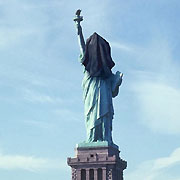
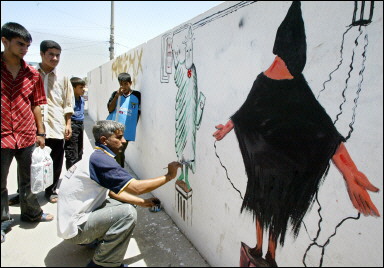
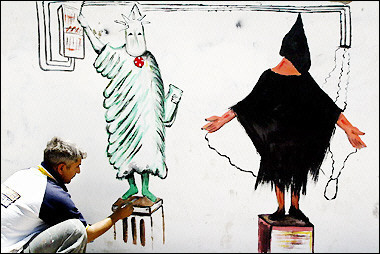
    In my recent search for statue of liberty stamp images, I ran across a few that comment on the situation in Iraq:


    I don't remember where I found these pictures.All 3 Statue of Liberty photos posted by Hello

    Update:

    I corrected the spelling of Hugo's name--I should have spotted it but Blogger's post creation window scrolls horizontally and Hugo's name was in the extreme right margin.

    Jesus looked up to heaven and said, "Father, I ask not only on behalf of these, but also on behalf of those who will believe in me through their word, that they may all be one. As you, Father, are in me and I am in you, may they also be in us, so that the world may believe that you have sent me."--John 17:20-21

    Friday, May 21, 2004

    Do I share God's desire...?

    Do I share God's desire to make of all the nations citizens of his Kingdom of justice, love and peace?

    From Catholic Ireland Zine:

    We need look no further than today's newspapers to see the shocking misuse of power in the prisons of Iraq. Nothing can justify that behaviour, which so degrades human beings. Power entrusted to the hands of a fallible human being can easily lead to distorted judgments and exploitative behaviour… The power over others that comes with military victory has been abused and it is right that such events be brought to light.
    – Most Rev Vincent Nichols, Archbishop of Birmingham
    Remember, it is our fallibility and weakness--our sinfulness--that make limits on power necessary. We should not trust people with power when they say "Trust us. We won't misuse our power."

    Also at Catholic Ireland Zine, an article by the late Father Niall O’Brien on Preemptive strikes for peace has caught my eye. Here are some excerpts:

    What will a future generation say of us who are so judgmental about the failures of previous generations? Today we know far more about what is going on in the Congo, Chechnya or the Middle East and have far greater possibilities of checking out the truth than our predecessors ever had. We have enormous financial and technical resources and still, for instance, nothing was done to stop the mass-destruction of half a million people in Rwanda or the slaughter of so many in Central America.

    War, often promoted by outside financial greed, is the main cause of suffering in many of these poverty stricken places. Someone described war as the ultimate poverty. In war you loose everything. We are paralyzed with horror by the abduction and murder of children here at home. Yet in the armed conflicts that are presently taking place two thousand children are killed or injured every single day.

    [snip]

    Peace is not just the absence of war or tension. Peacemaking involves scanning the horizon for those things that are the seeds of war and then undertaking deliberate preemptive work to remove them. Peacemaking means support for those unsung people who work at the various peace processes throughout the world. It demands an awareness of what is going on in the world around us and a commitment to confront the conditions and issues which produce war and oppression. It means taking time to study issues like the effect on children of sanctions in Iraq (which according to a visiting group of Nobel Prize winners cause up to 4,500 deaths every month); the reasons why Palestinians are prepared to blow themselves up; or the involvement of multinational companies in Africa's wars. Peacemaking means educating ourselves, taking stands on issues and continually praying for peace.

    [snip]

    What is the alternative, you ask? The short answer is active non-violence. As one who has studied and tried to promote non-violence over the years I am sometimes daunted by the ignorance of ordinary Christians about the possibility and effectiveness of non-violence as an alternative to war.

    Let me just say this: "Boy, do they prepare for war!" All those weapons, technology and research, all that discipline and money. And we expect nonviolence to work without preparation. God will provide! Not without our involvement!

    Non-violence is not a magic wand, but a disciplined way of life. It is an art that demands much study and training. An example of what it can achieve was the fall of President Marcos in the Philippines (1986). Those of us who lived through his oppression were familiar with his death squads, with their massacres and "disappearances". A friend once said to me: "maybe non-violence would work in India with Gandhi and the British – who were sort of gentlemen – but certainly not here in the Philippines." Not long afterwards the Marcos supporters watched with amazement as his regime crumbled before crowds armed with flowers, sandwiches, statues and prayers.

    [snip, to concluding paragraph:]

    Some time ago I edited a prayer book and when I came to the part on confession I put in at the beginning the question: Before thinking of confession have you yourself forgiven? I suddenly realized that I had never seen that as a requirement for confession before. Yet it is in every line of the Gospel, it is the lifeblood of the Christian story. Start with your own life. Learn to forgive, disarm your own heart. Then begin to think of ways to bring the Gospel of Peace to your own house, to your neighbourhood and to the wider world.
    I have been reading Simon Wiesenthal's book The Sunflower; On the Possibilities and Limits of Forgiveness. It is easy to understand the Christian responsibility to forgive sins against oneself. What authority does one have to forgive trespasses against others? This topic came up recently on Hugo Schwyzer's blog in a post entitled Nick Berg, anger, and pacifism:
    Look, I'm a Christian pacifist more than I am a "liberal". My pacifism is not situational. And it is not rooted in idealistic illusions about human nature, either. Before the Nick Berg video, I was not under the impression that the boys in Al Qaeda were nice, reasonable folks, who just needed to be shown the love of Christ in order to bring them around to civilization. Real pacifists have no doubts about the reality of human depravity! Human beings do awful, disgusting, beastly things to each other -- they've been doing those things for centuries; only recently have they insisted on filming themselves while they do it. So no, I haven't "changed my mind" about anything as a result of being presented with video evidence of barbarism.

    Most Christian pacifists throughout history have held to their pacifism in the face of incredible ugliness and persecution. I am tired of the accusation that Christian pacifism is a position of the "comfortably naive", while just war theory is the position of the (apparently) "responsibly wise". Pacifism flourished in the persecutions of 3rd century Rome, in 16th century Europe, and in 20th century South Africa. Sometimes the patient endurance of suffering impressed the oppressors so much that they rethought their oppression (the British in India), but most of the time, a lot of nice pacifists just got killed. I am a pacifist not because I believe that "love can change the world", but because I believe that God can and does act dramatically in human history to change what we cannot. I believe that to follow Christ is to foreswear the use of weapons, even in self-defense. I believe that the victory over death and evil has already been won by Christ, and my only job is to follow Him.

    Look, these are the musings of a childless man. (Pacifism, I'm told, gets a whole lot tougher when you have little ones). But despite what some of my more conservative and hawkish friends say (and they are truly friends), I am not a pacifist because I fail to comprehend the enormity of human wickedness, nor am I pacifist because I am a coward. I am a pacifist because my lord tells me that even while I grieve Nick Berg, and feel nausea and sadness and, yes, rage at his death, I must pray all the harder for the men who killed him. I must respond even to this unspeakable ugliness with love. If Nick Berg had been my brother, could I write those same words? In the short run, no; I would surely be overcome by an anger so intense that it blinded me. But in the end, no matter what my human emotions may be, I know the only way forward is forgiveness, and that, as my Savior taught me and as my church teaches, that forgiveness must be expressed in action. And responding to Nick Berg's death with violence is incompatible with that understanding of forgiveness.
    [emphasis in original]Then, read a comment by xlrq to this post:
    Sorry, Hugo, but this time you're on your own. Your concept of forgiveness is, quite frankly, whacked, both as a matter of Biblical theology and as a matter of basic morals. No one has the right to "forgive" the monsters who butchered Nick Berg. Only Berg himself has that right, and thanks to them, he is no longer capable of exercising it. All you have the right to forgive them for is the pain that their heinous act caused to YOU. The rest is not yours (or mine, or anyone else's) to forgive. If there's a God (which, as an agnostic, I will neither admit nor deny), then I'll concede that HE has that right. For anyone else to take it upon themselves to forgive a wrong committed against someone else is, I submit, to play God.

    But perhaps I err. Perhaps, when Jesus urged everyone to pray saying "forgive us our debts, as we forgive our debtors," he really meant "forgive us our debts, as we forgive each other's debtors." If that's how it works, have I got a deal for you: I'll forgive your mortgage if you forgive mine. I'm sure the banks will understand.
    [emphasis added] If it is true that only the murdered can forgive the murderers...

    And read Hugo Schwyzer's follow-up post on this topic:
    What does it mean to not "repay" evil with evil, when no evil has been done to me in the first place? How can I advocate turning the other cheek when my cheek has not been struck?
    [emphasis in original]


    Clap your hands, all you peoples;
    shout to God with loud songs of joy.
    For the LORD, the Most High, is awesome,
    a great king over all the earth.
    He subdued peoples under us, and nations under our feet.
    He chose our heritage for us, the pride of Jacob whom he loves.
    God has gone up with a shout, the LORD with the sound of a trumpet.
    Sing praises to God, sing praises;
    sing praises to our King, sing praises.
    For God is the king of all the earth;
    sing praises with a psalm.
    --Psalm 47:2-7 (46:2-7 in the Roman Catholic numbering of the Psalms)

    Saturday, May 15, 2004

    we should remember that we are messengers of Jesus’ gospel of peace

    not of “the Mennonite peace position.” From an editorial by Paul Schrag in Mennonite Weekly in which he discussed a speech by Richard Kauffman on “Communicating the Message of Peace to Skeptical Audiences”:
    Jesus desires all his followers to live peaceably, but many have failed to accept this essential part of his message.

    At the same time, peace advocates must be clear that they do not claim to know how to solve all the world’s problems quickly. Christian peacemaking “is not about the most expeditious way of dealing with violence in the short term,” Kauffman said. “Part of being a Christian is saying we don’t take short cuts. Jesus’ way of peace isn’t the shortest way.”

    Sometimes an effective way to stop violence, at least for a time, is to answer it in kind. We should admit that. But, eventually, violence breeds more of the same. Problems either aren’t solved, or they are traded for a new set of problems. We see this in Iraq: The invasion ousted Saddam Hussein but produced increasing terrorism against Iraqis and Americans.

    That’s the practical argument, and we should make it. But it’s not the most important one. Fundamentally, we don’t advocate peace because it works but because it is a response of faith, an unavoidable consequence of a decision to give our lives to Jesus completely. When faced with a choice between doing what “works” and being true to Christ, we hope and pray we will choose to act faithfully.
    Now the problem in Iraq is that the United States can't quickly disentangle itself without making things worse. How can the coalition forces leave without dumping Iraq into a bloody civil war and partition?


    Father, let me dedicate All this year to you
    In whatever earthly state You will have me be
    Not from sorrow, pain, or care Freedom dare I claim;
    This alone shall be my prayer: Glorify Your name.
    --from New Year's Hymn by Lawrence Tuttiett, 1864 (alt.)

    Saturday, May 01, 2004

    Tehran Times on abuse of Iraqi prisoners

    Here's how the it's covered in Iran--U.S. War Crimes: Torture of Iraqi Prisoners Exposed
    These acts of sadism and cruelty constitute a blatant violation of the “UN Convention against Torture and Other Cruel, Inhuman or Degrading Treatment or Punishment” and are war crimes as defined by Article 3 of the Geneva Conventions on the treatment of war prisoners. Article 3 prohibits: a. violence to life and person, in particular murder of all kinds, mutilation, cruel treatment and torture; b. taking hostages;

    c. outrages upon personal dignity, in particular humiliating and degrading treatment. Army Brigadier General Mark Kimmitt, deputy chief of military operations in Iraq, told “60 Minutes II” that the torture was “reprehensible” and claimed that those facing charges were “not representative” of American soldiers in Iraq. “Don’t judge your army by the actions of a few,” he said. Americans “need to understand that is not the Army.”

    These mendacious comments were refuted by CBS’s chilling interview with Army Reserve Staff Sergeant Chip Frederick, one of those facing court martial.

    Frederick, a Virginia prison guard, is charged with assaulting detainees, ordering prisoners to strike each other and an “indecent act” for observing one of the sexual abuse incidents. He insisted, however, that his actions were not those of a rogue soldier, but were sanctioned and encouraged by military intelligence and the CIA.

    Along with other reservist jail guards, he was directed to physically and mentally “prepare” Iraqi detainees for interrogation. He said that dogs were also used as “intimidation factors” against prisoners. One of Frederick’s email messages said: “Military intelligence has encouraged and told us ‘Great job.’ They usually don’t allow others to watch them interrogate. But since they like the way I run the prison, they have made an exception. We help getting them

    [detainees] to talk with the way we handle them.... We’ve had a very high rate with our style of getting them to break. They usually end up breaking within hours.”

    As these comments make clear, torture in US-run Iraqi prisons is an integral part of the illegal occupation. A systematic process of brutalization is being directed from the upper ranks.

    At the same time, the fact that US soldiers are employing methods similar to those used by the Nazis in World War II is indicative of a deep-seated state of demoralization and degradation that the occupation has bred within the US military. Finding themselves in a hostile environment with the vast majority of Iraqis opposing the occupation, many American soldiers have come to see the country’s entire population as the enemy. Fed lies about the colonial intervention in Iraq being part of a global “war on terrorism,” some have also assumed a license to torture and humiliate their helpless captives.

    Contrary to Kimmitt’s claims—slavishly echoed by the corporate media—this is the logic and modus operandi of imperialist conquest and colonial occupation. The pictures of torture, brutality and sexual sadism are representative of the entire criminal operation being conducted in Iraq.

    Saturday, April 17, 2004

    Winning Hearts and Minds in Iraq: Destruction of Relief Supplies and Rampage at the Aadhamiyah Mosque

    Rahul Mahajan (Empire Notes) reporting from Iraq -- This is What Occupation Looks Like -- Destruction of Relief Supplies and Rampage at the Aadhamiyah Mosque:
    We talked with Issam Rashid, the chief of security for the mosque. He told us the story. At 3:30 am on Sunday morning [April 11, 2004], 100 American troops raided the mosque. They were looking for weapons and mujaheddin. They started the raid the way they virtually always do -- by smashing in the gates with tanks and then driving Hummer in. The Hummers ran over and destroyed some of the stored relief goods (the bulk of the goods had already been sent to Fallujah -- over 200 tons -- but the amount remaining was considerable). More was destroyed as soldiers ripped apart sacks looking for rifles. Rashid estimated maybe three tons of supplies were destroyed. We saw for ourselves some of the remains, sacks of beans ripped apart and strewn around.

    The mosque was full of people, including 90 down from Kirkuk (many with the Red Crescent). They were all pushed down on the floor, with guns put to the backs of their heads. Another person associated with the mosque, Mr. Alber, who speaks very good English, told us that he repeatedly said, "Please, don't break down doors. Please, don't break windows. We can help you. We can have custodians unlock the doors." (Alber, by the way, was imprisoned by Saddam for running a bakery. As he said, "Under the embargo, you could eat flour, you could eat sugar, you could eat eggs, all separately. But mix them together and bake them and you were harming the economy by raising the price of sugar and you could get 15 years in prison.)

    The Americans refused to listen to Alber's pleas. We went all around the mosque and the adjacent madrassah, the Imam Aadham Islamic College. We saw dozens of doors broken down, windows broken, ceilings ripped apart, and bullet holes in walls and ceilings. The way the soldiers searched for illicit arms in the ceiling was first to spray the ceiling with gunfire, then break out a panel and go up and search.

    Mr. Mahajan comments in a follow-up post: "The dominant opinion in the United States, liberal or conservative, seems to be that we can't cut and run.":
    At the same time as their existence in Iraq provokes violence and as their brutal methods provoke violence, U.S. forces do nothing to provide security. Kidnappings of Iraqis for ransom are rife -- nobody ever investigates. Leading academics are being killed -- ditto. People are afraid to walk the streets after 9 or 10 -- nobody does anything about this. Women are far more constricted in getting around than they used to be. The list goes on and on. The U.S. military does nothing, absolutely nothing, about these security problems.

    Anyone who swallows any of this propaganda about "providing security" should spend one day talking to people in Iraq.

    I'm against the occupation for what I consider to be deep-lying structural reasons that would be valid even if it were conducted more humanely (I've written on this before, but I do have to collect all my scattered thoughts here and write about it again). But I have to say, from all of my experience interviewing Iraqis, one conclusion stands out clearly: had this occupation been carried out by British, Dutch, Bulgarians, Ukrainians, Spanish, everyone but the United States, the level of resentment would be far lower, as would the level of violence. It is the arrogance and brutality of the Americans here that is the primary grievance of Iraqis (and second is the negligence and the fact that nothing works).

    I wrote earlier about talking to Mr. Alber at the Abu Hanifa mosque. When we asked if the Americans apologized after raiding the mosque and finding nothing, he looked at us quizzically and then said, "No. A year ago, they would apologize. Now they don't even do that. But we know the American apology. We know what it means." While saying this, he mimed a savagely contorted face and a man taking his foot and grinding someone else into the ground. And, believe me, he is anything but an extremist. The people at the mosque have done their best to be conciliatory to the Americans.

    So a lot more has to be said about this issue. But the U.S. military is doing no good to Iraq -- unless you count taking Iraq's oil money and using a tiny fraction of it to pay corrupt contractors to paint schools for ten times the cost that Iraqis could do it for. Yes, the vast majority of the money spent on "reconstruction" (and aside from repainting I've seen precious little of it) comes from Iraq's own oil money. And it's causing huge amounts of violence. This is all hidden by the cut and run phraseology.

    Father, let me dedicate All this year to you
    In whatever earthly state You will have me be
    Not from sorrow, pain, or care Freedom dare I claim;
    This alone shall be my prayer: Glorify Your name.
    --from New Year's Hymn by Lawrence Tuttiett, 1864 (alt.)

    Friday, April 09, 2004

    If it weren't for the election, they'd be drafting troops now

    In 2000, the Republican Party promised "help is on the way" for the U.S. military. I wonder if the Republican-leaning officer corps still leans that way? Telegraph | News | US commander will not take blame for unrest:
    America's top commander in Iraq has warned Washington that he will not be "the fall guy" if violence in the country worsens, it emerged yesterday, as word leaked out that US generals are "outraged" by their lack of soldiers.

    America's generals consider current troop strengths of 130,000 in Iraq inadequate, reported the columnist Robert Novak, a doyen of the old-school Right in Washington.

    [snip]

    But officers who will not speak out in public let it be known that major reinforcements might be impossible to find. US forces are so overstretched in Iraq and Afghanistan that "there are simply no large units available and suitable for assignment", Novak wrote in his column in The Washington Post.

    The leaks have revived memories of the bitter debate that raged in Washington in the run-up to the Iraq war, as uniformed chiefs clashed with Mr Rumsfeld and his aides, who predicted that US forces would be welcomed as "liberators", allowing troop numbers to be reduced rapidly.

    Relations between the uniformed military and the Pentagon's civilian chiefs are currently worse than at any time in living memory, Novak wrote, citing a former high-ranking national security official who served in previous Republican administrations.

    Many still in uniform bitterly recall the public dressing-down earned by the then army chief of staff, Gen Eric Shinseki, when he told Congress a month before the invasion, in February 2003, that "several hundred thousand troops" might be needed to occupy Iraq.

    That estimate was slapped down as "wildly off the mark" by the deputy defence secretary, Paul Wolfowitz. Thomas White, the army secretary and a former general himself, publicly backed Gen Shinseki. Mr White was sacked shortly afterwards by Mr Rumsfeld.

    A new account of the war, In the Company of Soldiers, reveals that in May 2003 Pentagon planners "predicted that US troop levels would be down to 30,000 by late summer [of 2003]".
    The Republican Platform for 2004 should read: "The Bush Administration: where wishful thinking prevails."

    Sunday, February 29, 2004

    Here's something the 'liberal media' will bury

    John Kerry's speech:
    Fighting a Comprehensive War on Terrorism Here are some excerpts:
    This war isn’t just a manhunt – a checklist of names from a deck of cards. In it, we do not face just one man or one terrorist group. We face a global jihadist movement of many groups, from different sources, with separate agendas, but all committed to assaulting the United States and free and open societies around the globe.

    As CIA Director George Tenet recently testified: “They are not all creatures of bin Laden, and so their fate is not tied to his. They have autonomous leadership, they pick their own targets, they plan their own attacks.”

    At the core of this conflict is a fundamental struggle of ideas. Of democracy and tolerance against those who would use any means and attack any target to impose their narrow views.

    The War on Terror is not a clash of civilizations. It is a clash of civilization against chaos; of the best hopes of humanity against dogmatic fears of progress and the future.

    Like all Americans, I responded to President Bush’s reassuring words in the days after September 11th. But since then, his actions have fallen short.

    I do not fault George Bush for doing too much in the War on Terror; I believe he’s done too little.
    Here are some of the main points of Senator Kerry's plan:
    First, if I am President I will not hesitate to order direct military action when needed to capture and destroy terrorist groups and their leaders. George Bush inherited the strongest military in the world – and he has weakened it. What George Bush and his armchair hawks have never understood is that our military is about more than moving pins on a map or buying expensive new weapons systems.

    America’s greatest military strength has always been the courageous, talented men and women whose love of country and devotion to service lead them to attempt and achieve the impossible everyday.

    [snip: the Bush administration's failures]

    Second, if I am President I will strengthen the capacity of intelligence and law enforcement at home and forge stronger international coalitions to provide better information and the best chance to target and capture terrorists even before they act.

    But the challenge for us is not to cooperate abroad; it is to coordinate here at home. Whether it was September 11th or Iraq’s supposed weapons of mass destruction, we have endured unprecedented intelligence failures. We must do what George Bush has refused to do – reform our intelligence system by making the next Director of the CIA a true Director of National Intelligence with real control of intelligence personnel and budgets. We must train more analysts in languages like Arabic. And we must break down the old barriers between national intelligence and local law enforcement.

    In the months leading up to September 11th, two of the hijackers were arrested for drunk driving – and another was stopped for speeding and then let go, although he was already the subject of an arrest warrant in a neighboring county and was on a federal terrorist watch list. We need to simplify and streamline the multiple national terrorist watch lists and make sure the right information is available to the right people on the frontlines of preventing the next attack.

    [snip: the Bush administration's failures]

    Third, we must cut off the flow of terrorist funds. In the case of Saudi Arabia, the Bush Administration has adopted a kid-glove approach to the supply and laundering of terrorist money. If I am President, we will impose tough financial sanctions against nations or banks that engage in money laundering or fail to act against it. We will launch a "name and shame" campaign against those that are financing terror. And if they do not respond, they will be shut out of the U.S. financial system.

    Fourth, because finding and defeating terrorist groups is a long-term effort, we must act immediately to prevent terrorists from acquiring nuclear, chemical, or biological weapons. I propose to appoint a high-level Presidential envoy empowered to bring other nations together to secure and stop the spread of these weapons. We must develop common standards to make sure dangerous materials and armaments are tracked, accounted for, and secured. Today, parts of Russia’s vast nuclear arsenal are easy prey for those offering cash to scientists and security forces who too often are under-employed and under-paid. If I am President, I will expand the Nunn/Lugar program to buy up and destroy the loose nuclear materials of the former Soviet Union and to ensure that all of Russia’s nuclear weapons and materials are out of the reach of terrorists and off the black market.

    [snip: our responsibility in Iraq and Afghanistan]

    But nothing else will matter unless we win the war of ideas. In failed states from South Asia to the Middle East to Central Africa, the combined weight of harsh political repression, economic stagnation, lack of education, and rapid population growth presents the potential for explosive violence and the enlistment of entire new legions of terrorists. In Saudi Arabia and Egypt, almost sixty percent of the population is under the age of 30, unemployed and unemployable, in a breeding ground for present and future hostility. And according to a Pew Center poll, fifty percent or more of Indonesians, Jordanians, Pakistanis, and Palestinians have confidence in bin Laden to “do the right thing regarding world affairs”

    We need a major initiative in public diplomacy to bridge the divide between Islam and the rest of the world. For the education of the next generation of Islamic youth, we need an international effort to compete with radical Madrassas. We have seen what happens when Palestinian youth have been fed a diet of anti-Israel propaganda. And we must support human rights groups, independent media and labor unions dedicated to building a democratic culture from the grass-roots up. Democracy won't come overnight, but America should speed that day by sustaining the forces of democracy against repressive regimes and by rewarding governments which take genuine steps towards change.

    We cannot be deterred by letting America be held hostage by energy from the Middle East. If I am President, we will embark on a historic effort to create alternative fuels and the vehicles of the future – to make this country energy independent of Mideast oil within ten years. So our sons and daughters will never have to fight and die for it.

    [snip: more on the homeland security front]

    And our children’s future demands that we also do everything in our power to prevent the creation of tomorrow’s terrorists today. Maybe there’s no going back to the days before baggage checks and orange alerts. Maybe they’re with us forever. But I don’t believe they have to be. I grew up at a time of bomb shelters and air raid drills. But America had leaders of vision and courage in both parties. And today, the Cold War is memory, not reality.

    I believe we can bring a real victory in the War on Terror. I believe we must, not only for ourselves but for all who look to America as “the last best hope of earth.” I believe we can meet that ideal – and that’s why I’m running for President.

    Wednesday, February 25, 2004

    The Passion of the Christ

    I will not be watching this movie. It apparently is not satisfied with the biblical accounts: it adds fiction to the facts, and claims that it is factual. Here's a review by Philippa Hawker in The Age [Australian newspaper]:
    There have been statements, from Gibson and from his supporters, that The Passion of the Christ is distinguished by its fidelity to the gospels, a claim which seems disingenuous.
    Apart from the difficulty of being faithful to a set of accounts that don't always agree, much of the film is concerned with imagining precisely what's left out of the gospels - graphic detail of physical punishment and suffering.
    And there are numerous additions, above and beyond dramatisation and interpretation.
    There's a punitive scene involving a crow pecking out the eyes of one of the criminals crucified alongside Jesus.
    A single drop of water (a divine tear?) is shown falling from the skies after Jesus's death, in a vertiginous shot from the heights.
    Gibson inserts a demonic figure, seen only to Jesus, who addresses and undermines him, and who turns up, at the end, with a weird-looking baby swaddled in black clothing. (In the credits, this figure is called Satan, and is played by an androgynous-looking woman, Rosalinda Celentano).
    Pontius Pilate (Hristo Naumov Shopov) is given a wife, Claudia (Claudia Gerini), a compassionate figure who pleads with her husband not to condemn Jesus.
    Ms. Hawker concludes her review with these comments:
    Yet it is hard to imagine what elements of this film would inspire conversion, or comfort believers.

    The sustained, insistent violence, over more than two hours, becomes distancing and repetitive, with moments of excess that border on absurdity.

    It is, in the end, not much more than a grim and perplexing test of endurance.
    I heard one reviewer say that the violence of the movie reaches Monty Pythonesque levels.
    If you want to see a good movie about Jesus, try The Gospel According to Saint Matthew by Italian Communist and homosexual Pier Paolo Pasolini. It burns with Jesus' righteous anger at sin and injustice, and is much truer to the text.
    Update
    No sooner do I end this post, I Google Pasolini and find this review by Richard Nilsen in The Arizona Republic which concludes with this:
    The best movie Jesus: In 1966, Italian director Pier Paolo Pasolini created The Gospel According to St. Matthew, an austere black-and-white film that lets the words speak for themselves without tricking them up with cinematic wizardry. Using only amateur actors found in the Sicilian villages where Pasolini shot, his film is one of the most moving and believable ever. Perhaps it takes a homosexual Communist Italian to find the right tone for the Gospel.
    I can't make the claim that Pasolini's movie is the best, since I haven't seen most of the ones Mr. Nilson lists. Grounds for further research . . .

    Wednesday, November 12, 2003

    Good News: "Guatemala's Pinochet" Rios Montt defeated

    Al Jazeera reports:
    With 85% of votes counted, conservative businessman and landowner Oscar Berger led with 35% support.

    A former Guatemala City mayor backed by the country's wealthy elite and the main newspapers, Berger fell short of an outright majority.

    He now faces a runoff on 28 December against leftist politician Alvaro Colom, who won about 26% of the vote.

    Rios Montt, who ruled the impoverished Central American nation with an iron fist in the early 1980s, trailed with 17%.
    Guatemalan security forces, trained and equipped by the CIA, massacred, kidnapped, and tortured "leftist" Mayan villagers.
    Aljazeera's report highlighted President Clinton's apology for US support for the repressive Guatemalan government of the 1980s:
    "For the United States, it is important I state clearly that support for military forces and intelligence units which engaged in violence and widespread repression was wrong and the United States must not repeat that mistake."

    US President Bill Clinton
    March 1999

    Three Guatemalan newspapers are on the Web (presumably all supporters of Oscar Berger):
  • Siglo XXI

  • Prensa Libre

  • La Hora


  • Don't be hateful to people, just because they are hateful to you. Rather, be good to each other and to everyone else. Always be joyful and never stop praying. Whatever happens, keep thanking God because of Jesus Christ. This is what God wants you to do. --1st Thessalonians 5:15-18 CEV