Sunday, October 24, 2004

Questioning Mr. Bush's Faith?

Ayelish McGarvey, a writer at the American Prospect, questions Mr. Bush's faith in this online article--As God Is His Witness

Is Mr. Bush even a Christian? If you listen carefully, you can hear all the pundits scurrying away, muttering 'Who am I to judge the sincerity of President Bush's faith?' while Mr. Bush uses the Christian faith as political propaganda:
Ironically for a man who once famously named Jesus as his favorite political philosopher during a campaign debate, it is remarkably difficult to pinpoint a single instance wherein Christian teaching has won out over partisan politics in the Bush White House. Though Bush easily weaves Christian language and themes into his political communication, empty religious jargon is no substitute for a bedrock faith. Even little children in Sunday school know that Jesus taught his disciples to live according to his commandments, not simply to talk about them a lot. In Bush's case, faith without works is not just dead faith -- it's evangelical agitprop.

Richard Land directs the Ethics and Religious Liberty Commission of the conservative Southern Baptist Convention, the nation's largest Protestant denomination and a group that enjoys a close relationship with the Bush administration. In an interview for Frontline earlier this year, Land denounced the scriptural cherry-picking on the part of contemporary American Christians. "It's only been in the last half-century when you've had the rise of groups [in] modern Christendom who believe in what I call 'Dalmatian theology,'" he explained. "The Bible's inspired in spots, and . . . [t]hey think they can reject large chunks of Christian Scripture and biblical revelation that they don't agree with . . . ."

But while Land's censure was probably intended for liberals, so, too, does it apply to the president. For George W. Bush does not live or govern under the complete authority of the Bible -- just the parts that work to his political advantage. And evangelical leaders like Land who blindly bless the Bush White House don't just muddy the division of church and state; worse, they completely violate Scripture.
Contrast Mr. Bush with Mr. Carter:
But sin is crucial to Christianity. To be born again, a seeker must painfully acknowledge his or her innate sinfulness, and then turn away from it completely. And though today Bush is sober, he does not live and govern like a man who "walks" with God, using the Bible as a moral compass for his decision making. Twice in the past year -- once during an April press conference and most recently at a presidential debate -- the president was unable to name any mistake he has made during his term. His steadfast unwillingness to fess up to a single error betrays a strikingly un-Christian lack of attention to the importance of self-criticism, the pervasiveness of sin, and the centrality of humility, repentance, and redemption. Indeed, it is impossible to imagine George W. Bush delivering an address like Jimmy Carter's legendary "malaise" speech (in which he did not actually say the word "malaise") in 1979. Carter sermonized to a dispirited nation in the language of confession, sacrifice, and spiritual restoration. Though it didn't do him a lick of good politically, it was consonant with a Christian theology of atonement: Carter admitted his mistakes to make right with God and the American people, politics be damned. Bush, for whom politics is everything, can't even admit that he's done anything wrong.

Save for a few standout reporters, the press has done a dismal job of covering the president's very public religiosity. Overwhelmingly lacking personal familiarity with conservative Christianity, political reporters have either avoided the topic or resorted to shopworn cliches and lazy stereotypes. Over and over, news stories align Bush with evangelical theology while loosely dropping terms like fundamentalist to describe his beliefs.

Once and for all: George W. Bush is neither born again nor evangelical. As Alan Cooperman reported in The Washington Post last month, the president has been careful never to use either term to describe his faith. Unlike millions of evangelicals, Bush did not have a single born-again experience; instead, he slowly came to Christianity over the course of several years, beginning with a deep conversation with the Reverend Billy Graham in the mid-1980s. And there is virtually no evidence that Bush places any emphasis on evangelizing -- or spreading the gospel -- in either his personal or professional life. Contrast this to Carter, who notoriously told every foreign dignitary he encountered about the good news of Jesus Christ.
Many evangelicals will vote for Mr. Bush because they think he is one of them. They are mistaken.

Father, let me dedicate All this year to you
In whatever earthly state You will have me be
Not from sorrow, pain, or care Freedom dare I claim;
This alone shall be my prayer: Glorify Your name.
--from New Year's Hymn by Lawrence Tuttiett, 1864 (alt.)

Friday, October 22, 2004

A Light Bulb Joke

Found at William Gibson's blog:
How many Bush administration officials does it take to change a light bulb?

None. There's nothing wrong with that light bulb. There is no need to change anything. We made the right decision and nothing has happened to change our minds. People who criticize this light bulb now, just because it doesn't work anymore, supported us when we first screwed it in, and when these flip-floppers insist on saying that it is burned out, they are merely giving aid and encouragement to the Forces of Darkness.

-- John Cleese


Father, let me dedicate All this year to you
In whatever earthly state You will have me be
Not from sorrow, pain, or care Freedom dare I claim;
This alone shall be my prayer: Glorify Your name.
--from New Year's Hymn by Lawrence Tuttiett, 1864 (alt.)

Thursday, October 21, 2004

Inside Mr. Bush's Brain, January Surprise Version

Mark A. R. Kleiman noticed something in the Ron Suskind article in NYT Magazine that I missed:
Meanwhile, the Kerry campaign has decided that none of the truly horrifying quotes in the Susskind article have the political potency of Bush's promise to a group of his rich supporters to privatize Social Security in a second term.

I love the phrase "January surprise." The Bush spokesman who pointed out that Bush never says "privatization" in public leaves himself open to the riposte that Bush did use the word when talking his fundraisers.
Here is the relevant piece of the Suskind piece--notice that Mr. Bush does not use this in his stump speeches, just when raising fund from his true base, the ultra-rich:
''I'm going to come out strong after my swearing in,'' Bush said, ''with fundamental tax reform, tort reform, privatizing of Social Security.'' The victories he expects in November, he said, will give us ''two years, at least, until the next midterm. We have to move quickly, because after that I'll be quacking like a duck.''


Father, let me dedicate All this year to you
In whatever earthly state You will have me be
Not from sorrow, pain, or care Freedom dare I claim;
This alone shall be my prayer: Glorify Your name.
--from New Year's Hymn by Lawrence Tuttiett, 1864 (alt.)
Tinkering

I have been tinkering with Ghost Town Orange's template; you may notice a few new bells and whistles, and some old ones repaired. In particular, I restored the Weather and Upcoming News Sources pages--find the links to the right.

Ghost Town Orange is over a year old. I need to clean up the archives--remove dead links, restore pictures that are no longer hosted, and eliminate some obsolete information about prior versions of Ghost Town Orange. Developing...

Father, let me dedicate All this year to you
In whatever earthly state You will have me be
Not from sorrow, pain, or care Freedom dare I claim;
This alone shall be my prayer: Glorify Your name.
--from New Year's Hymn by Lawrence Tuttiett, 1864 (alt.)

More on Republican attempts to steal the election

Blogger Markos Moulitsas [Daily Kos] has a good article in the UK Guardian which summarizes the Republican Party's attempt to suppress Democratic votes. After summarizing problems in several states, Mr. Moulitsas sums up:
There is more, lots more. There are several clearing houses of voter suppression and fraud online, like the Voter Registration Fraud Clearinghouse and Vote Watch 2004.

These efforts are not isolated incidents, but part of the Republican Party's "Victory" programme. While ostensibly a voter registration and "get out the vote" operation, the programme includes a concerted nationwide effort by Republicans to lock in their electoral gains by any and all means necessary. Sounds like partisan rhetoric, sure, until you hear it from the source. Alluding to the fraud committed by his party in his home state of South Dakota, former Republican governor and congressman Bill Janklow told the Associated Press last week that the entire Victory programme is rife with electoral fraud: "These people are cheating. When you tamper with it, you cheat the system. And cheating in elections is the worst form of cancer because it's uncontrollable."

Father, let me dedicate All this year to you
In whatever earthly state You will have me be
Not from sorrow, pain, or care Freedom dare I claim;
This alone shall be my prayer: Glorify Your name.
--from New Year's Hymn by Lawrence Tuttiett, 1864 (alt.)

Tuesday, October 19, 2004

Inside Mr. Bush's Brain, Orwellian version

Needlenose remembers a certain similarity between the Bush White House and George Orwell's 1984:
Ron Suskind's chilling article in the New York Times Magazine on Dubya's "faith-based presidency" has plenty of people sitting up and taking notice. Joshua Marshall quotes this remark by former Environmental Protection Administration chief Christie Whitman:
In meetings, I'd ask if there were any facts to support our case. And for that, I was accused of disloyalty!
Others such as Matt Yglesias and Daily Kos, cite this disturbing passage:
The aide said that guys like me were ''in what we call the reality-based community,'' which he defined as people who ''believe that solutions emerge from your judicious study of discernible reality.'' I nodded and murmured something about enlightenment principles and empiricism. He cut me off. ''That's not the way the world really works anymore,'' he continued. ''We're an empire now, and when we act, we create our own reality. And while you're studying that reality -- judiciously, as you will -- we'll act again, creating other new realities, which you can study too, and that's how things will sort out. We're history's actors . . . and you, all of you, will be left to just study what we do.''
It didn't take long for me to realize what this reminded me of:
You believe that reality is something objective, external, existing in its own right. You also believe that the nature of reality is self-evident. When you delude yourself into thinking that you see something, you assume that everyone else sees the same thing as you. But I tell you, Winston, that reality is not external. . . . Whatever the Party holds to be the truth, is truth. It is impossible to see reality except by looking through the eyes of the Party.
Yes, you guessed right about the source -- George Orwell's 1984, the Bushites' instruction manual. And if they get four more years in power ...
I had always feared that the distopia of Aldous Huxley's Brave New World was more likely than Orwell's 1984; now I'm not so sure.

Father, let me dedicate All this year to you
In whatever earthly state You will have me be
Not from sorrow, pain, or care Freedom dare I claim;
This alone shall be my prayer: Glorify Your name.
--from New Year's Hymn by Lawrence Tuttiett, 1864 (alt.)

Saturday, October 16, 2004

Kerry supporter threatened with snipers

From the Des Moines Register: "Campaign event security spurs arrests, removals"
One of the latest incidents came when John Sachs, 18, a Johnston High School senior and Democrat, went to see Bush in Clive last week. Sachs got a ticket to the event from school and wanted to ask the president about whether there would be a draft, about the war in Iraq, Social Security and Medicare.

But when he got there, a campaign staffer pulled him aside and made him remove his button that said, "Bush-Cheney '04: Leave No Billionaire Behind." The staffer quizzed him about whether he was a Bush supporter, asked him why he was there and what questions he would be asking the president.

"Then he came back and said, 'If you protest, it won't be me taking you out. It will be a sniper,' " Sachs said. "He said it in such a serious tone it scared the crap out of me."

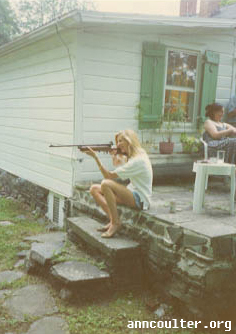
Perhaps the Hippie Chick Pie Wagon has volunteered her services to the Bush campaign.  Posted by Hello
Sachs stayed at the event, but he was escorted to a section of the 7 Flags Events Center where he was surrounded by Secret Service and told he couldn't ask questions. "I was just in a state of fear," he said. "I was looking at the ceiling and I didn't know what to expect, I was so scared."

Ronayne said he wasn't aware of what happened to Sachs and declined to comment further. "To the best of my knowledge, no one's lives have been threatened at an event," he said.

Sachs' situation is the latest in a string of stories in which Iowans attending Bush campaign events said they've been made to feel unwelcome.

Other incidents include five protesters arrested outside an event in Cedar Rapids; black and Hispanic students frisked in Davenport; and two people denied admission in Dubuque because they either didn't support Bush or were affiliated with someone who didn't.

Iowa's stories are similar to those being told around the country. According to media reports, Missouri students were in tears after they were removed from a Bush rally because they were wearing Kerry buttons. Others in Minnesota and Wisconsin were asked to leave Bush rallies because they had Kerry T-shirts or stickers.

Thursday night, police wearing riot gear fired pepperballs at protesters gathered at a hotel in Jacksonville, Ore., where Bush was scheduled to eat and sleep after a campaign speech. No one was injured, but two were arrested on charges of failure to disperse. Participants questioned the police intervention because they said they weren't violent or disrupting traffic.
Seriously, the Secret Service needs to be investigated for co-operating with the Bush/Cheney campaign's methods of stifling dissent. Senator Kerry will have some house-cleaning to do when he gets into the White House.

Father, let me dedicate All this year to you
In whatever earthly state You will have me be
Not from sorrow, pain, or care Freedom dare I claim;
This alone shall be my prayer: Glorify Your name.
--from New Year's Hymn by Lawrence Tuttiett, 1864 (alt.)

Inside Mr. Bush's Brain

Ron Suskind in the New York Times Magazine: Without a Doubt. On Bush's lack of curiosity:
Some officials, elected or otherwise, with whom I have spoken with left meetings in the Oval Office concerned that the president was struggling with the demands of the job. Others focused on Bush's substantial interpersonal gifts as a compensation for his perceived lack of broader capabilities. Still others, like Senator Carl Levin of Michigan, a Democrat, are worried about something other than his native intelligence. ''He's plenty smart enough to do the job,'' Levin said. ''It's his lack of curiosity about complex issues which troubles me.'' But more than anything else, I heard expressions of awe at the president's preternatural certainty and wonderment about its source.
And here is a bit about how Bush's education actually stifles his ability to be intellectually flexible:
[Senator Joseph]Biden, who early on became disenchanted with Bush's grasp of foreign-policy issues and is among John Kerry's closest Senate friends, has spent a lot of time trying to size up the president. ''Most successful people are good at identifying, very early, their strengths and weaknesses, at knowing themselves,'' he told me not long ago. ''For most of us average Joes, that meant we've relied on strengths but had to work on our weakness -- to lift them to adequacy -- otherwise they might bring us down. I don't think the president really had to do that, because he always had someone there -- his family or friends -- to bail him out. I don't think, on balance, that has served him well for the moment he's in now as president. He never seems to have worked on his weaknesses.''

Bush has been called the C.E.O. president, but that's just a catch phrase -- he never ran anything of consequence in the private sector. The M.B.A. president would be more accurate: he did, after all, graduate from Harvard Business School. And some who have worked under him in the White House and know about business have spotted a strange business-school time warp. It's as if a 1975 graduate from H.B.S. -- one who had little chance to season theory with practice during the past few decades of change in corporate America -- has simply been dropped into the most challenging management job in the world.

One aspect of the H.B.S. method, with its emphasis on problems of actual corporations, is sometimes referred to as the ''case cracker'' problem. The case studies are static, generally a snapshot of a troubled company, frozen in time; the various ''solutions'' students proffer, and then defend in class against tough questioning, tend to have very short shelf lives. They promote rigidity, inappropriate surety. This is something H.B.S. graduates, most of whom land at large or midsize firms, learn in their first few years in business. They discover, often to their surprise, that the world is dynamic, it flows and changes, often for no good reason. The key is flexibility, rather than sticking to your guns in a debate, and constant reassessment of shifting realities. In short, thoughtful second-guessing.
And when Mr. Bush
was elected leader of the free world and began ''case cracking'' on a dizzying array of subjects, proffering his various solutions, in both foreign and domestic affairs. But the pointed ''defend your position'' queries -- so central to the H.B.S. method and rigorous analysis of all kinds -- were infrequent. Questioning a regional supervisor or V.P. for planning is one thing. Questioning the president of the United States is another.

Still, some couldn't resist. As I reported in ''The Price of Loyalty,'' at the Bush administration's first National Security Council meeting, Bush asked if anyone had ever met Ariel Sharon. Some were uncertain if it was a joke. It wasn't: Bush launched into a riff about briefly meeting Sharon two years before, how he wouldn't ''go by past reputations when it comes to Sharon. . . . I'm going to take him at face value,'' and how the United States should pull out of the Arab-Israeli conflict because ''I don't see much we can do over there at this point.'' Colin Powell, for one, seemed startled. This would reverse 30 years of policy -- since the Nixon administration -- of American engagement. Such a move would unleash Sharon, Powell countered, and tear the delicate fabric of the Mideast in ways that might be irreparable. Bush brushed aside Powell's concerns impatiently. ''Sometimes a show of force by one side can really clarify things.''

Such challenges -- from either Powell or his opposite number as the top official in domestic policy, Paul O'Neill -- were trials that Bush had less and less patience for as the months passed. He made that clear to his top lieutenants. Gradually, Bush lost what Richard Perle, who would later head a largely private-sector group under Bush called the Defense Policy Board Advisory Committee, had described as his open posture during foreign-policy tutorials prior to the 2000 campaign. (''He had the confidence to ask questions that revealed he didn't know very much,'' Perle said.) By midyear 2001, a stand-and-deliver rhythm was established. Meetings, large and small, started to take on a scripted quality. Even then, the circle around Bush was tightening. Top officials, from cabinet members on down, were often told when they would speak in Bush's presence, for how long and on what topic. The president would listen without betraying any reaction. Sometimes there would be cross-discussions -- Powell and Rumsfeld, for instance, briefly parrying on an issue -- but the president would rarely prod anyone with direct, informed questions.
We all see the results of Mr. Bush surrounding himself with yes-men--the befuddled and angry performances at the debates and press conferences, the stubborn insistence that he is right, and the perverse fear that any change of mind is a sign of weakness. He is a man that cannot admit he makes mistakes. He is unfit to be the President of the United States. We must vote him out of office on November 3.

Father, let me dedicate All this year to you
In whatever earthly state You will have me be
Not from sorrow, pain, or care Freedom dare I claim;
This alone shall be my prayer: Glorify Your name.
--from New Year's Hymn by Lawrence Tuttiett, 1864 (alt.)

Funniest obituary ever

In the London Times, on Jacques Derrida.
Can there be any certainty in the death of Jacques Derrida? The obituarists' objective attempts to place his life in a finite context are, necessarily, subject to epistemic relativism, the idea that all such scientific theories are mere "narrations" or social constructions. Surely, a postmodernist deconstruction of their import would inevitably question the foundational conceptual categories of prior science -- among them, Derrida's own existence -- which become problematised and relativised. . . .

Father, let me dedicate All this year to you
In whatever earthly state You will have me be
Not from sorrow, pain, or care Freedom dare I claim;
This alone shall be my prayer: Glorify Your name.
--from New Year's Hymn by Lawrence Tuttiett, 1864 (alt.)

Thursday, October 14, 2004

Osama been forgotten

"Gosh, I just don't think I ever said I'm not worried about Osama bin Laden. It's kind of one of those exaggerations."
-- George W. Bush, 10/13/04

"I don't know where he is and I really don't care. It's not that important. It's not our priority."
-- George W. Bush, 5/13/02

UPDATE 7:35 PM CDT

And to think, this is a man that accuses Senator Kerry of flip-flopping.

Father, let me dedicate All this year to you
In whatever earthly state You will have me be
Not from sorrow, pain, or care Freedom dare I claim;
This alone shall be my prayer: Glorify Your name.
--from New Year's Hymn by Lawrence Tuttiett, 1864 (alt.)

Neither Compassionate nor Conservative

Amy Sullivan has an interesting article in the Washinton Monthly about President Bush's faith based policies: Faith Without Works.

Read the whole thing, but here is the concluding two paragraphs:
On the third night of the Republican convention, one of the many gauzy "W." video-mercials that appeared on giant screens in the middle of Madison Square Garden during slow stretches featured images of Bush surrounded by people of color, while in a voiceover the president reminded viewers, "I rallied the armies of compassion." More than with any other piece of his domestic policy agenda, Bush has linked himself personally to the faith-based initiative. During a campaign stop in March, he told a crowd of religious leaders that he--and he alone--was responsible for the changes that have taken place. "Congress wouldn't act," Bush said, "so I signed an executive order--that means I did it on my own."

And so he did. Bush alone is responsible for supporting the distribution of taxpayer dollars without requiring proof that the funding produces results, for establishing a new government bureaucracy to give special help to a "discriminated" community that has always been on equal footing with everyone else, and for encouraging religious organizations to rely on government funding instead of encouraging private donations. It turns out that a "compassionate conservative" is a different kind of Republican after all. Just not the kind we expected.
And here is an opposing view: Ira J. Hadnot interviews Jim Towey, a pro-life Democrat who runs the White House Office of Faith-Based and Community Initiatives.


Father, let me dedicate All this year to you
In whatever earthly state You will have me be
Not from sorrow, pain, or care Freedom dare I claim;
This alone shall be my prayer: Glorify Your name.
--from New Year's Hymn by Lawrence Tuttiett, 1864 (alt.)

Tuesday, October 12, 2004

The Annual Columbus Day Post

A post from last year revisited--
Let's remember what Christopher Columbus was really like:
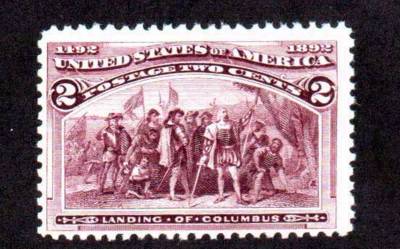
United States Postage Stamp, 1893--the Landing of Columbus
Landing of Columbus stamp, 1893 Posted by Hello

On his second voyage, at Hispaniola (the large island that is now Haiti and the Dominican Republic) Columbus and his men devised a system to extract gold from the native population:
Every man and woman, every boy or girl of fourteen or older, in the province of Cibao (of the imaginary gold fields) had to collect gold for the Spaniards. As their measure, the Spaniards used those same miserable hawk's bells, the little trinkets they had given away so freely when they first came 'as if from Heaven.' Every 3 months, every Indian had to bring to one of the forts a hawk's bell filled with gold dust. The chiefs had to bring in about ten times that amount. In the other provinces of Hispaniola, twenty-five pounds of spun cotton took the place of gold.

Copper tokens were manufactured, and when an Indian had brought his or her tribute to an armed post, he or she received such a token, stamped with the month, to be hung around the neck. With that they were safe for another three months while collecting more gold.

Whoever was caught without a token was killed by having his or her hands cut off. There are old Dutch prints (I saw them in the collection of Bishop Voegeli of Haiti) that show this being done: the Indians stumble away, staring with surprise at their arm stumps pulsing out blood.

There were no gold fields, and thus, once the Indians had handed in whatever they still had in gold ornaments, their only hope was to work all day in the streams, washing out gold dust from the pebbles. It was an impossible task, but those Indians who tried to flee into the mountains were systematically hunted down with dogs and killed, to set an example for the others to keep trying.
Resistance was futile: "It was at this time that the mass suicides began: the Arawaks killed themselves with cassava poison." --from Columbus: his Enterprise; Exploding the Myth by Hans Koning, based on the reports by Bartolome de las Casas.

Perhaps you think we should not judge Columbus by the standards of today--surely in the light of the 15th century he was a great and noble hero!

Apparently there were plenty of men of that distant and benighted age that criticized Columbus and the Spanish misbehavior in the Americas; among them are Bartolome de las Casas, Antonio de Montesino, Fray Buil, Pedro Margarit, and the Dutch etcher DeBry. So do not believe the lie that plundering, raping and massacring people was somehow considered acceptable behavior in the past. It wasn't.

Even Samuel Eliot Morison, in Christopher Columbus, Mariner an otherwise quite positive portrayal of the hero Columbus admits that "the cruel policy initiated by Columbus and pursued by his successors resulted in complete genocide."

I have recently been reading A View of the Causes and Consequences of the American Revolution; in Thirteen Discourses, Preached in North America between the Years 1763 and 1775: with an historical preface by Jonathan Boucher, apparently an Anglican minister that returned to England after the outbreak of the American Revolution. The first sermon, "On the Peace in 1763" includes this reminder of what true greatness is:
True greatness deserves all the honour that the world can pay to it: but, fields dyed with blood are not the scenes in which true greatness is most likely to be found. He who simplifies a mechanical process, who supplies us with a new convenience or comfort, or even he who contrives an elegant superfluity, is, in every proper sense of the phrase, a more useful man than any of those masters in the art of destruction, who, to the shame of the world, have hitherto monopolized almost all its honours.
Amen.

Father, let me dedicate All this year to you
In whatever earthly state You will have me be
Not from sorrow, pain, or care Freedom dare I claim;
This alone shall be my prayer: Glorify Your name.
--from New Year's Hymn by Lawrence Tuttiett, 1864 (alt.)