Do I share God's desire to make of all the nations citizens of his Kingdom of justice, love and peace?
From Catholic Ireland Zine:
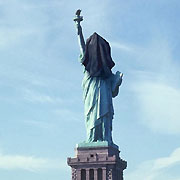
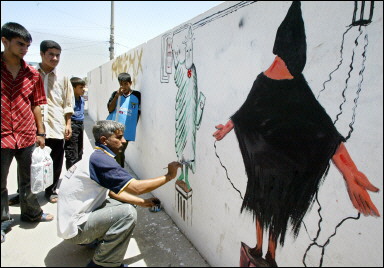
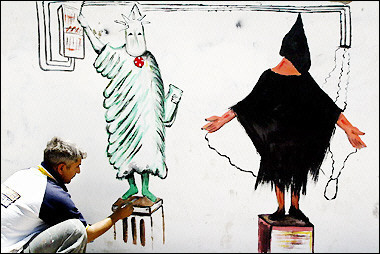
We need look no further than today's newspapers to see the shocking misuse of power in the prisons of Iraq. Nothing can justify that behaviour, which so degrades human beings. Power entrusted to the hands of a fallible human being can easily lead to distorted judgments and exploitative behaviour… The power over others that comes with military victory has been abused and it is right that such events be brought to light.
– Most Rev Vincent Nichols, Archbishop of Birmingham
Remember, it is our fallibility and weakness--our sinfulness--that make limits on power necessary. We should not trust people with power when they say "Trust us. We won't misuse our power."
Also at Catholic Ireland Zine, an article by the late Father Niall O’Brien on Preemptive strikes for peace has caught my eye. Here are some excerpts:
What will a future generation say of us who are so judgmental about the failures of previous generations? Today we know far more about what is going on in the Congo, Chechnya or the Middle East and have far greater possibilities of checking out the truth than our predecessors ever had. We have enormous financial and technical resources and still, for instance, nothing was done to stop the mass-destruction of half a million people in Rwanda or the slaughter of so many in Central America.
War, often promoted by outside financial greed, is the main cause of suffering in many of these poverty stricken places. Someone described war as the ultimate poverty. In war you loose everything. We are paralyzed with horror by the abduction and murder of children here at home. Yet in the armed conflicts that are presently taking place two thousand children are killed or injured every single day.
[snip]
Peace is not just the absence of war or tension. Peacemaking involves scanning the horizon for those things that are the seeds of war and then undertaking deliberate preemptive work to remove them. Peacemaking means support for those unsung people who work at the various peace processes throughout the world. It demands an awareness of what is going on in the world around us and a commitment to confront the conditions and issues which produce war and oppression. It means taking time to study issues like the effect on children of sanctions in Iraq (which according to a visiting group of Nobel Prize winners cause up to 4,500 deaths every month); the reasons why Palestinians are prepared to blow themselves up; or the involvement of multinational companies in Africa's wars. Peacemaking means educating ourselves, taking stands on issues and continually praying for peace.
[snip]
What is the alternative, you ask? The short answer is active non-violence. As one who has studied and tried to promote non-violence over the years I am sometimes daunted by the ignorance of ordinary Christians about the possibility and effectiveness of non-violence as an alternative to war.
Let me just say this: "Boy, do they prepare for war!" All those weapons, technology and research, all that discipline and money. And we expect nonviolence to work without preparation. God will provide! Not without our involvement!
Non-violence is not a magic wand, but a disciplined way of life. It is an art that demands much study and training. An example of what it can achieve was the fall of President Marcos in the Philippines (1986). Those of us who lived through his oppression were familiar with his death squads, with their massacres and "disappearances". A friend once said to me: "maybe non-violence would work in India with Gandhi and the British – who were sort of gentlemen – but certainly not here in the Philippines." Not long afterwards the Marcos supporters watched with amazement as his regime crumbled before crowds armed with flowers, sandwiches, statues and prayers.
[snip, to concluding paragraph:]
Some time ago I edited a prayer book and when I came to the part on confession I put in at the beginning the question: Before thinking of confession have you yourself forgiven? I suddenly realized that I had never seen that as a requirement for confession before. Yet it is in every line of the Gospel, it is the lifeblood of the Christian story. Start with your own life. Learn to forgive, disarm your own heart. Then begin to think of ways to bring the Gospel of Peace to your own house, to your neighbourhood and to the wider world.
I have been reading
Simon Wiesenthal's book
The Sunflower; On the Possibilities and Limits of Forgiveness. It is easy to understand the Christian responsibility to forgive sins against oneself. What authority does one have to forgive trespasses against others? This topic came up recently on Hugo Schwyzer's blog in a post entitled
Nick Berg, anger, and pacifism:
Look, I'm a Christian pacifist more than I am a "liberal". My pacifism is not situational. And it is not rooted in idealistic illusions about human nature, either. Before the Nick Berg video, I was not under the impression that the boys in Al Qaeda were nice, reasonable folks, who just needed to be shown the love of Christ in order to bring them around to civilization. Real pacifists have no doubts about the reality of human depravity! Human beings do awful, disgusting, beastly things to each other -- they've been doing those things for centuries; only recently have they insisted on filming themselves while they do it. So no, I haven't "changed my mind" about anything as a result of being presented with video evidence of barbarism.
Most Christian pacifists throughout history have held to their pacifism in the face of incredible ugliness and persecution. I am tired of the accusation that Christian pacifism is a position of the "comfortably naive", while just war theory is the position of the (apparently) "responsibly wise". Pacifism flourished in the persecutions of 3rd century Rome, in 16th century Europe, and in 20th century South Africa. Sometimes the patient endurance of suffering impressed the oppressors so much that they rethought their oppression (the British in India), but most of the time, a lot of nice pacifists just got killed. I am a pacifist not because I believe that "love can change the world", but because I believe that God can and does act dramatically in human history to change what we cannot. I believe that to follow Christ is to foreswear the use of weapons, even in self-defense. I believe that the victory over death and evil has already been won by Christ, and my only job is to follow Him.
Look, these are the musings of a childless man. (Pacifism, I'm told, gets a whole lot tougher when you have little ones). But despite what some of my more conservative and hawkish friends say (and they are truly friends), I am not a pacifist because I fail to comprehend the enormity of human wickedness, nor am I pacifist because I am a coward. I am a pacifist because my lord tells me that even while I grieve Nick Berg, and feel nausea and sadness and, yes, rage at his death, I must pray all the harder for the men who killed him. I must respond even to this unspeakable ugliness with love. If Nick Berg had been my brother, could I write those same words? In the short run, no; I would surely be overcome by an anger so intense that it blinded me. But in the end, no matter what my human emotions may be, I know the only way forward is forgiveness, and that, as my Savior taught me and as my church teaches, that forgiveness must be expressed in action. And responding to Nick Berg's death with violence is incompatible with that understanding of forgiveness.
[emphasis in original]Then, read a comment by
xlrq to this post:
Sorry, Hugo, but this time you're on your own. Your concept of forgiveness is, quite frankly, whacked, both as a matter of Biblical theology and as a matter of basic morals. No one has the right to "forgive" the monsters who butchered Nick Berg. Only Berg himself has that right, and thanks to them, he is no longer capable of exercising it. All you have the right to forgive them for is the pain that their heinous act caused to YOU. The rest is not yours (or mine, or anyone else's) to forgive. If there's a God (which, as an agnostic, I will neither admit nor deny), then I'll concede that HE has that right. For anyone else to take it upon themselves to forgive a wrong committed against someone else is, I submit, to play God.
But perhaps I err. Perhaps, when Jesus urged everyone to pray saying "forgive us our debts, as we forgive our debtors," he really meant "forgive us our debts, as we forgive each other's debtors." If that's how it works, have I got a deal for you: I'll forgive your mortgage if you forgive mine. I'm sure the banks will understand.
[emphasis added] If it is true that only the murdered can forgive the murderers...
And read
Hugo Schwyzer's follow-up post on this topic:
What does it mean to not "repay" evil with evil, when no evil has been done to me in the first place? How can I advocate turning the other cheek when my cheek has not been struck?
[emphasis in original]
Clap your hands, all you peoples;
shout to God with loud songs of joy.
For the LORD, the Most High, is awesome,
a great king over all the earth.
He subdued peoples under us, and nations under our feet.
He chose our heritage for us, the pride of Jacob whom he loves.
God has gone up with a shout, the LORD with the sound of a trumpet.
Sing praises to God, sing praises;
sing praises to our King, sing praises.
For God is the king of all the earth;
sing praises with a psalm.
--Psalm 47:2-7 (46:2-7 in the Roman Catholic numbering of the Psalms)



 page views since October 5, 2003